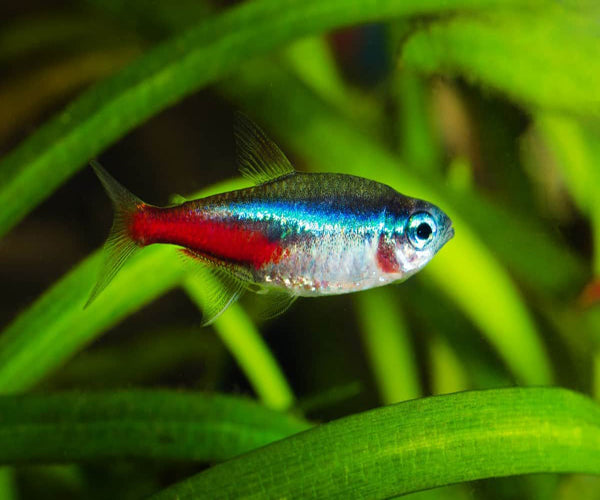


The neon tetra is a Freshwater fish of the characin family of order Characiformes. The type species of its genus, it is native to blackwater and clearwater streams in the Amazon basin of South America.
=> PLANTED TANK FISHES
=>COMPATABLE WITH GUPPIES ,ANY TETRAS,SHRIMPS .
=>EASY TO MAINTAIN
About & Origin
The Neon Tetra (Paracheirodon innesi) is one of the most recognisable fish in the hobby, instantly identified by the iridescent blue-green stripe running the length of its body above a bright red lower half. It comes from the clearwater and blackwater tributaries of the Amazon basin in Peru, Colombia, and Brazil, where it shoals in large numbers through shaded, tannin-stained forest streams.
In the wild that shading and the sheer number of fish moving together is a defence against predators — a lone neon stands out and stresses easily, while a tight-packed shoal of 20 or more becomes a shimmering, confusing blur. That instinct carries straight into the aquarium: neons kept in groups that are too small tend to hide, lose colour, and look washed out, while a proper shoal displays its full colour and confidence.
It has been a cornerstone of the community aquarium hobby since the 1930s, prized for being small, peaceful, inexpensive, and strikingly colourful under the right lighting and substrate.
The Neon Tetra (Paracheirodon innesi) is arguably the single most recognisable aquarium fish in the world, native to clear and blackwater tributaries of the Amazon basin in Peru, Colombia, and Brazil.
Its brilliant iridescent blue-to-turquoise horizontal stripe over a bright red lower body and tail is produced by light-reflecting cells (iridophores) rather than pigment alone, which is why the colour appears to shift and glow depending on the angle and lighting.
First described in the 1930s, it triggered one of the biggest crazes in aquarium history and remains one of the best-selling freshwater fish today, almost all of it now farmed rather than wild-caught.
Despite decades of captive breeding, it has never lost its popularity, remaining one of the top-selling freshwater aquarium fish worldwide year after year.
Requirements
Neon tetras are true shoaling fish and should never be kept in groups smaller than 6 — ideally 10 or more, in as large a group as the tank allows. A single neon, or a pair, will spend most of its time stressed and hiding rather than out and swimming.
A planted tank with subdued lighting and some floating cover suits them best and brings out their colour most strongly; under harsh, bare lighting they tend to look pale. They do well in a community of similarly small, peaceful fish, and should not be housed with anything large enough to see them as food.
Diet is easy — a good quality micro pellet or flake, supplemented with occasional live or frozen foods like daphnia or brine shrimp for extra colour and conditioning. They are not fussy eaters once settled.
A classic shoaling fish — keep in groups of 8-10 or more for natural, confident schooling behaviour and to show its best colour; small groups tend to be visibly more stressed and washed out.
Peaceful and easy to house with a wide range of similarly small, non-aggressive community fish, but best avoided with anything large enough to see it as food.
Takes standard flake and micro pellets readily, with small live or frozen foods appreciated for conditioning, particularly if breeding is of interest.
A cycled, established tank is far safer for a new shoal than a freshly set-up system, since ammonia and nitrite spikes during cycling are a leading cause of early losses in small schooling characins. Weekly partial water changes of 20–30% and stable, mature filtration matter more to long-term neon health than chasing any single exact water parameter.
It accepts flake, micro pellets, and small live/frozen foods without fuss, and does best fed in small, frequent amounts rather than one large feeding, since overfeeding is a common cause of water-quality issues in densely shoaled nano/community setups.
Compatibility


Water & Care Conditions
Neons are adaptable once acclimated, but they show their best colour and are least stressed within these ranges:
- pH: 6.0–7.0 (soft, slightly acidic water closest to their native blackwater streams, though they tolerate a wider 5.5–7.5 range)
- Salinity / hardness: freshwater only, soft water (2–10 dGH preferred)
- Temperature: 20–26°C (68–79°F) — on the cooler side for a tropical fish, avoid consistently pushing past 27°C
- Light: subdued to moderate; bright, harsh lighting without cover tends to wash out their colour and stress the shoal
- Oxygenation: standard community-tank filtration and gentle flow is sufficient; they are not tolerant of poor water quality or ammonia/nitrite spikes, so stable, cycled water matters more than any single parameter
- Buying tip: choose only active, brightly coloured stock from a tank with no visibly sick or dead fish, since Neon Tetra Disease can spread through weakened batches before symptoms are obvious
- Feeding: small, frequent feedings of flake or micro pellets suit its small mouth and shoaling feeding style
- Longevity: can live 5-8 years in a stable, mature, well-maintained tank
- Tank position: stays mainly in the middle water column, especially when shoaling
- Filtration: gentle to moderate flow suits neons best, avoiding strong current that can stress a small shoal
Soft, slightly acidic water closest to its native blackwater habitat is ideal for long-term health and colour, though captive-bred stock has become considerably more tolerant of moderate hardness over decades of farming.
Neons are known to be susceptible to "Neon Tetra Disease," a specific parasitic illness — buying healthy-looking, active stock and maintaining stable water quality are the best preventive measures.
Weekly partial water changes of 20-30% help keep Neons colourful and active, since like most small characins and rasboras it's sensitive to accumulating nitrates and organic waste over time even though it isn't considered a delicate species.
A mature, cycled tank with established biological filtration is a much safer home for a new shoal than a freshly set-up system, since ammonia and nitrite spikes during cycling are a common cause of losses in small schooling fish.