About & Origin
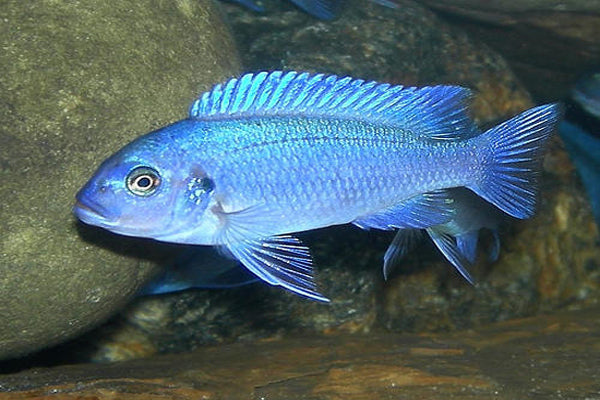
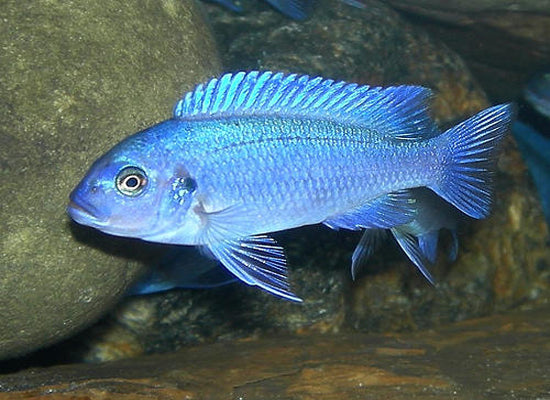
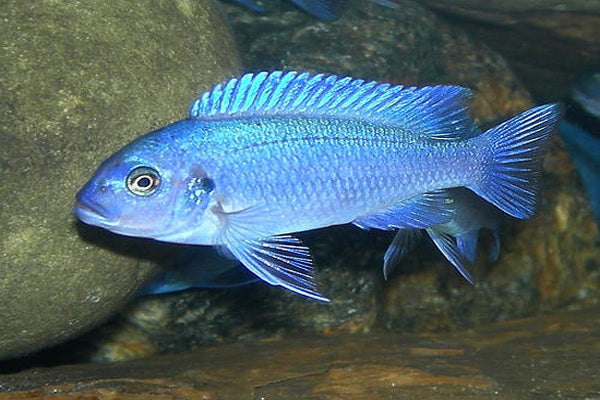
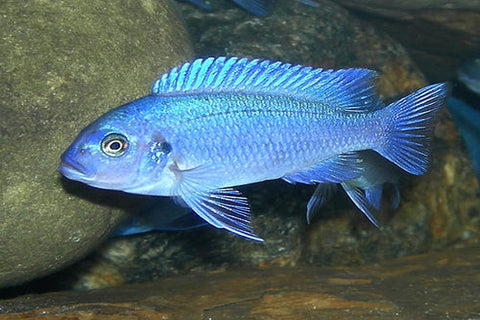
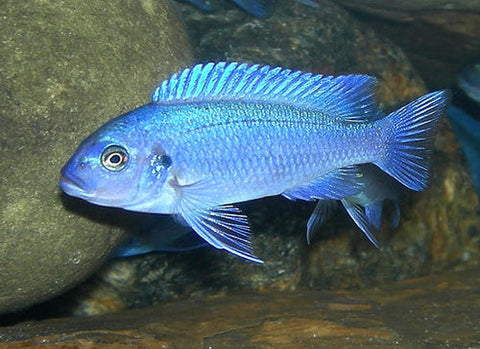
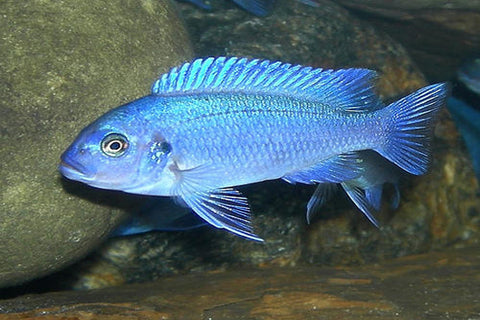
The Powder Blue mbuna (Pseudotropheus socolofi) is a soft powder-blue cichlid, sometimes edged in black along the fins, from the rocky shoreline habitats of Lake Malawi — a classic mbuna, meaning it's an algae-grazing, rock-dwelling species adapted to picking "aufwuchs" (the algae/microorganism film) off rock surfaces rather than a predator or open-water forager.
Compared to many other mbuna, socolofi has a reputation for being one of the calmer, more manageable members of the group — still a territorial rift lake cichlid, but less relentlessly combative than species like Johanni or many Melanochromis, which makes it a common recommendation for a first mbuna tank.
Males and females are similarly coloured (unlike many dichromatic mbuna), both showing the soft powder-blue base colour, which makes sexing this species harder than most and usually requires checking for the small egg-spot markings on the male's anal fin rather than relying on colour.
As with other mbuna, it's a maternal mouthbrooder, carrying fertilized eggs in her mouth for around three weeks before releasing free-swimming fry — a genuinely easy species to breed, and one that will often do so unprompted in a well-established mbuna community once fish reach maturity.
Adults reach roughly 10-12 cm (4-5 inches), on the smaller side for a mbuna, and a well-kept individual can live eight to ten years or more. Because the calmer temperament is relative to other mbuna rather than absolute, buyers coming from a peaceful community-fish background should still expect a genuinely territorial, rock-defending cichlid rather than anything resembling a docile tetra or livebearer.
The soft, even powder-blue colouring (sometimes with a darker dorsal edge) is fairly stable and doesn't vary as dramatically with mood or stress as some other mbuna's colours do, which is part of why the species has a reputation as an easygoing, reliable-looking addition to a mixed mbuna tank.
Requirements
200+ litres (55+ US gallons), heavily rockscaped with caves and broken sightlines, following standard mbuna tank design principles.
Temperament: semi-aggressive — calmer than many mbuna, but still a territorial rock-dweller that does best in a dedicated mbuna community rather than with peaceful non-African community fish.
Diet: vegetable-forward — spirulina-based flake or pellet as the staple, occasional protein only; like other mbuna, prone to Malawi bloat on a protein-heavy diet. Feeding small amounts several times a day rather than one large feeding also reduces bloat risk.
Filtration and water changes: mbuna generate a heavy bioload for their size, so filtration rated above the tank's stated volume plus weekly 25-30% water changes with temperature- and hardness-matched water are standard practice, not optional extras.
Mixing with other mbuna: because this species is relatively mild-mannered, pairing it with only similarly calm mbuna (rather than notably aggressive species like Johanni or many Melanochromis) avoids it being bullied and outcompeted for food and territory.
Group composition: since sexing is difficult, a mixed group bought as juveniles will typically sort itself into a natural mix of males and females over time — buying a larger group of six or more juveniles improves the odds of ending up with a workable, non-lopsided ratio.
Décor: dense rockwork is essential, not optional, for this and any mbuna species — several separate rock piles with clear sightline breaks between them work better than one continuous ridge, since it lets subordinate fish retreat out of a dominant male's line of sight.
Stocking: because it's relatively calm for a mbuna, it's often used to "anchor" a mixed mbuna community alongside more excitable tankmates, but it still benefits from being kept in a small group of its own kind rather than as a single specimen.
Compatibility
Water & Care Conditions
These parameters follow the natural chemistry of Lake Malawi's Rift Valley water — they aren't flexible in the way softer-water community fish can be:
- pH: 7.8–8.6 (Lake Malawi is naturally hard and alkaline — this is not optional, low-pH water stresses these fish over time)
- Water hardness: 10–20 dGH (200–350 ppm); many keepers add crushed coral or aragonite sand to the substrate/filter to hold pH and hardness up long-term
- Temperature: 24–28°C (75–82°F)
- Oxygenation: strong surface agitation and filtration — Malawi cichlids are messy, heavily-stocked-tank fish that need robust biological filtration and large, regular water changes
- Ammonia/nitrite: zero at all times in a mature tank — stress from poor water quality is a common trigger for Malawi bloat, which progresses quickly and is far easier to prevent than treat
- Water changes: weekly changes of 25-30% with hardness/temperature-matched water hold parameters steady, which matters more for rift lake cichlids than for most community fish since they evolved in a remarkably stable natural environment
Test kits for pH, ammonia, nitrite, and nitrate are worth running weekly while a tank is still cycling and maturing, then monthly once stable, since buffering material like crushed coral gradually loses effectiveness and can let pH drift down without any obvious visual warning sign until fish begin to show stress. Watch for the early signs of Malawi bloat -- appetite loss, laboured breathing, pale stringy faeces, and abdominal swelling -- since it is much easier to head off early with a water change and a short fast than to treat once advanced. New water used for changes should be matched to tank temperature and, ideally, hardness before it goes in, rather than added straight from a typically softer tap supply, to avoid repeated swings in chemistry.
As with other mbuna, keep the diet vegetable-forward — see Requirements.