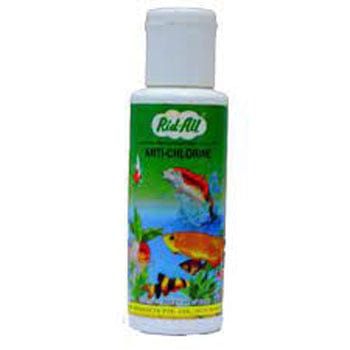
About & Origin
Rid-All Anti Chlorine is a water conditioner from the Rid-All range, used to neutralise chlorine and chloramine in tap water before it's added to a freshwater aquarium — the same core job as any dechlorinator, treating the gap between water that's safe for humans to drink and water that's safe for fish to live in.
Chlorine and chloramine are added to most municipal water supplies specifically because they're effective at killing bacteria and pathogens — which is exactly why they're harmful to fish, whose gills and slime coat are far more sensitive to these chemicals than human skin.
As part of the wider Rid-All line (which also includes general aid and anti-ich products), it's designed to be used alongside the rest of the range as part of a routine aquarium maintenance and treatment kit.
Chlorine and chloramine aren't the only reason to condition tap water either -- many municipal supplies also carry trace heavy metals from ageing pipework, and a good dechlorinator typically neutralises several of these alongside the chlorine/chloramine itself, giving broader protection than chlorine removal alone.
Unlike a specific medication aimed at one illness, a dechlorinator is used every single time fresh tap water enters the tank, making it one of the most frequently reached-for bottles in a fishkeeper's whole collection.
Skipping dechlorination isn't a minor oversight -- chlorine directly damages gill tissue and strips away the protective slime coat, and the resulting stress and physical damage can be severe enough to kill fish outright in a large enough water change, not just cause mild discomfort. It's one of the few genuinely non-negotiable steps in routine fishkeeping.
Some dechlorinators go further and also detoxify ammonia and nitrite temporarily, which is useful during an emerging cycling problem or a sudden ammonia spike, though this shouldn't be relied on as a long-term substitute for actually fixing the underlying water-quality issue. Check your specific bottle's label to see whether it offers this broader protection or focuses on chlorine/chloramine alone.
Requirements
Every water change: dose into fresh tap water each time you top up or change water, rather than saving it for occasional use.
Dosing: follow the ratio on the bottle for your tank/water volume.
Acts quickly: no need to let treated water stand before adding it to the tank.
Pairs naturally with the rest of the Rid-All range if you're already using their general aid or anti-ich products, since all three are designed around the same basic freshwater maintenance routine.
Chloramine specifically: plain chlorine will slowly gas off if water is left standing uncovered for a day or two, but chloramine is far more stable and essentially won't dissipate on its own -- if your local water authority uses chloramine, a chemical dechlorinator like this isn't optional, it's the only practical way to make that water safe quickly.
Combine with routine testing: even with a reliable dechlorinator in use, periodically testing tap water parameters (pH, hardness) helps you understand what you're actually adding to the tank at every water change.
Direct dosing vs pre-treating: most modern dechlorinators work fast enough to dose directly into the tank as new water is added, rather than needing a separate holding container of pre-treated water -- check your specific bottle to confirm this applies to it.
Top-ups too, not just full water changes: topping off water lost to evaporation still needs dechlorinating, since evaporation removes only water, not the dissolved chlorine/chloramine left behind.
New tank setup: treat every bucket of water used to fill a new tank before it goes in, not just ongoing maintenance water changes -- an untreated tank fill is one of the most common beginner mistakes.
Large-volume mixing: for bigger tanks or fishrooms treating water in a barrel or drum before use, mix the dechlorinator in thoroughly rather than dosing at the top of a large static volume, so treatment reaches all the water evenly before it's used.
Compatibility
Dosage & Usage Guidelines
Dose per the ratio on the bottle for your water volume, every time you add fresh tap water.
- Use: every water change
- Neutralises: chlorine and chloramine
- Storage: cool, dark place, tightly sealed
- Check your water authority's treatment method (chlorine vs. chloramine) if unsure which applies to your tap water
- Works within seconds to minutes, no need to pre-age treated water
- Applies to top-ups too: evaporation-replacement water needs dechlorinating just like a full water change
- Storage life: check for a use-by date; a bottle that's discoloured or has an off smell is best replaced
- Shake before use if the label recommends it -- some formulations can settle over time
- Keep on hand at all times: this is one product no freshwater tank should ever run out of, since a water change with untreated tap water can cause acute harm
- New tank fills: treat the entire volume used to first fill a new tank, not just later top-ups
- Some formulations also detoxify ammonia/nitrite temporarily: a useful bonus during a cycling emergency, check your bottle's label
- Large volumes: mix thoroughly through the whole batch when treating water in a barrel or drum rather than dosing only at the surface
- Pairs with: the rest of the Rid-All range for a complete routine maintenance and treatment kit
- Not a substitute for testing: a dechlorinator handles chlorine/chloramine, but doesn't tell you your tap water's pH or hardness -- test those separately if unsure
- Cheap relative to how essential it is: a small bottle treats a large number of water changes, making it one of the best-value products in the hobby
A small bottle goes a long way since only a few millilitres are needed per typical water change -- one of the cheapest, most routine products in the hobby relative to how essential it is.