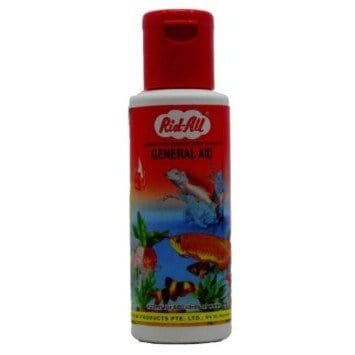
- Is a famous standard preparation used as a cure and more as a general prevention of most fish diseases commonly faced by the aquarium trade.
- It is widely used in fish farms and hatcheries all over the world; and by exporters of aquarium fishes to cut down mortality rates during transit.
- Unlike most Acriflavine based products "RID-ALL" General Aid will not cause the lethal egg binding in most aquarium fish.
About & Origin
Rid-All General Aid is a well-established general-purpose treatment for freshwater aquarium fish, used both for prevention and as a first-line cure for many of the most common problems fishkeepers run into — ich, mouth and body fungus, fin and tail rot, torn fins, and sore spots.
It's widely used commercially in fish farms and by exporters shipping live fish, specifically to reduce mortality during the stress of transport — a strong indicator that it's a reliable general workhorse rather than a niche or narrow-spectrum product.
A point some keepers specifically look for: unlike many older general-purpose remedies that rely on Acriflavine as their active ingredient, Rid-All General Aid does not, which avoids Acriflavine's known side effect of causing egg-binding in some aquarium fish — worth knowing if you keep breeding stock.
The Acriflavine-free formulation is a genuinely meaningful distinction for anyone breeding fish at home -- Acriflavine, a common active ingredient in many older general treatments, is well documented to interfere with egg viability and cause egg-binding in females of several popular species, so a keeper with breeding stock specifically benefits from choosing a general remedy that avoids it.
As a broad-spectrum product, it's aimed at the class of symptoms that are common across many different underlying causes -- clamped fins, visible white spots, cottony growths, frayed or reddened fin edges, and general listlessness -- rather than requiring a precise diagnosis before treatment starts. That breadth is exactly what makes it useful as a reasonable first response while a more specific issue, if there is one, is identified.
The 120ml size is a larger format suited to keepers running multiple tanks or treating a larger display, where a smaller bottle would need frequent replacing during an active outbreak or an extended preventive routine.
Requirements
As a treatment: for ich, fungus, or fin/tail rot, a typical approach is dosing directly into the affected fish's water alongside a small amount of aquarium salt.
As a preventive tonic: a lighter, more dilute dose is used regularly, particularly when introducing new fish, or as routine prevention for young/vulnerable fish.
Safety: it's described as economical, safe, and non-toxic to both aquarium plants and fish at the recommended dose, making it reasonable to use directly in a planted display rather than requiring a separate hospital tank.
Because it covers such a wide range of common problems, it's a sensible first product to reach for when a fish looks off but the exact cause isn't obvious yet.
Export-grade reliability: being widely used commercially by fish exporters (who have a direct financial incentive to minimise mortality during shipping) is a reasonably strong real-world signal of a product's reliability across a broad range of common problems, beyond just marketing claims.
Aquarium salt pairing: the common practice of adding a small amount of aquarium salt alongside this treatment isn't arbitrary -- salt itself has mild antiparasitic and osmotic-stress-relief properties for many freshwater species, complementing rather than duplicating what the medication does.
When it's not enough: if symptoms don't improve within a few days of treatment, or worsen, that's a sign to move to a more targeted medication or consult a more specific diagnosis rather than continuing to redose the general remedy indefinitely.
Quarantine new arrivals: a light preventive dose during a standard quarantine period for newly purchased fish is a common, low-risk habit that can catch minor stress-related issues before they develop into something worse in the main display.
Dosing accuracy matters more at treatment strength: the higher active-treatment dose is where getting the ratio right actually matters, since it's the concentration most likely to cause any sensitivity in delicate fish or fry -- measure carefully rather than estimating for that dose specifically.
Compatibility

Dosage & Usage Guidelines
Two dosing strengths apply depending on purpose:
- Active treatment (ich, fungus, fin/tail rot): commonly around 5ml with a teaspoon of aquarium salt per 5 litres of water
- General prevention/tonic: a lighter dose, commonly around 5ml per 25 litres, used weekly or when adding new fish
- Safe for: both fish and live aquarium plants at recommended doses
- Storage: cool, dark place, tightly sealed
- Acriflavine-free, a meaningful distinction if you breed fish at home
- Widely used commercially by fish farms and exporters for transport mortality reduction
- Salt pairing: aquarium salt added alongside treatment provides its own mild antiparasitic/osmotic benefit
- Reassess after a few days: if there's no improvement, consider a more targeted treatment rather than continuing indefinitely
- Shelf life: check for a use-by date and discard a bottle that's changed colour or developed sediment
- Not a substitute for good husbandry: repeated illness in a tank usually points to an underlying water-quality or stocking issue worth investigating alongside treatment
- Quarantine use: a light preventive dose during quarantine of new arrivals is a common, low-risk precaution
- Larger 120ml size: economical for multi-tank keepers or extended treatment courses versus a smaller bottle
- Measure treatment doses carefully: the stronger active-treatment ratio is where accuracy matters most, more so than the light maintenance dose
- Keep the bottle on hand: broad-spectrum and safe at maintenance strength, reasonable to have ready before a problem shows up rather than only buying reactively
Always confirm the exact ratio on your own bottle, as formulations and concentrations can be adjusted between batches. Because it's genuinely broad-spectrum and safe at both treatment and maintenance doses, it's reasonable to keep a bottle on hand permanently rather than only buying one once a problem shows up.