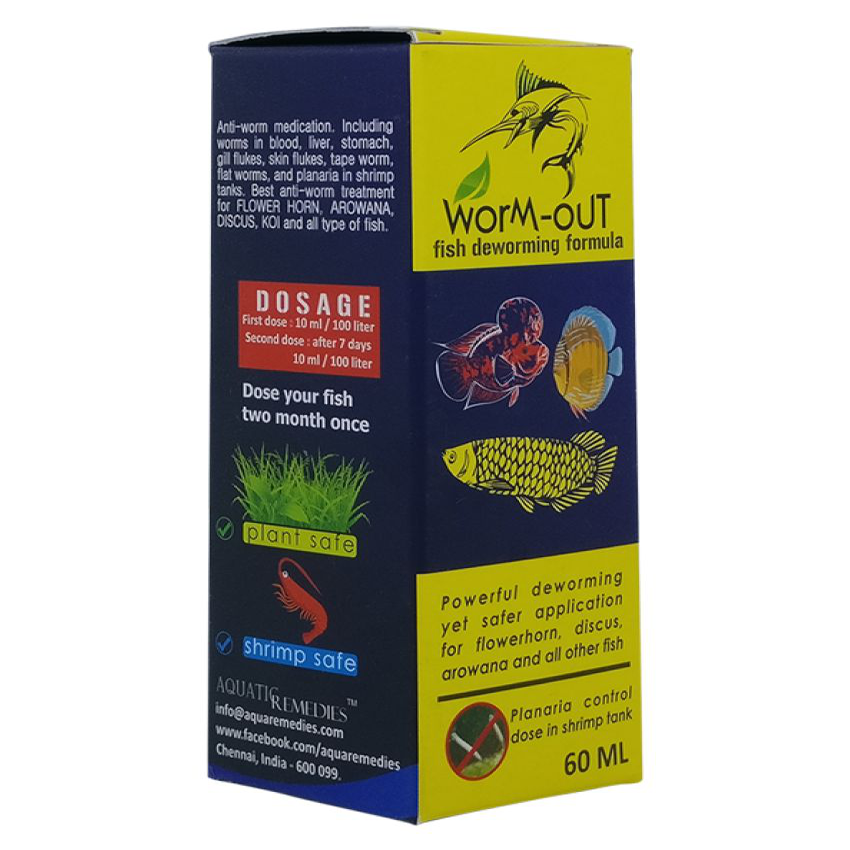
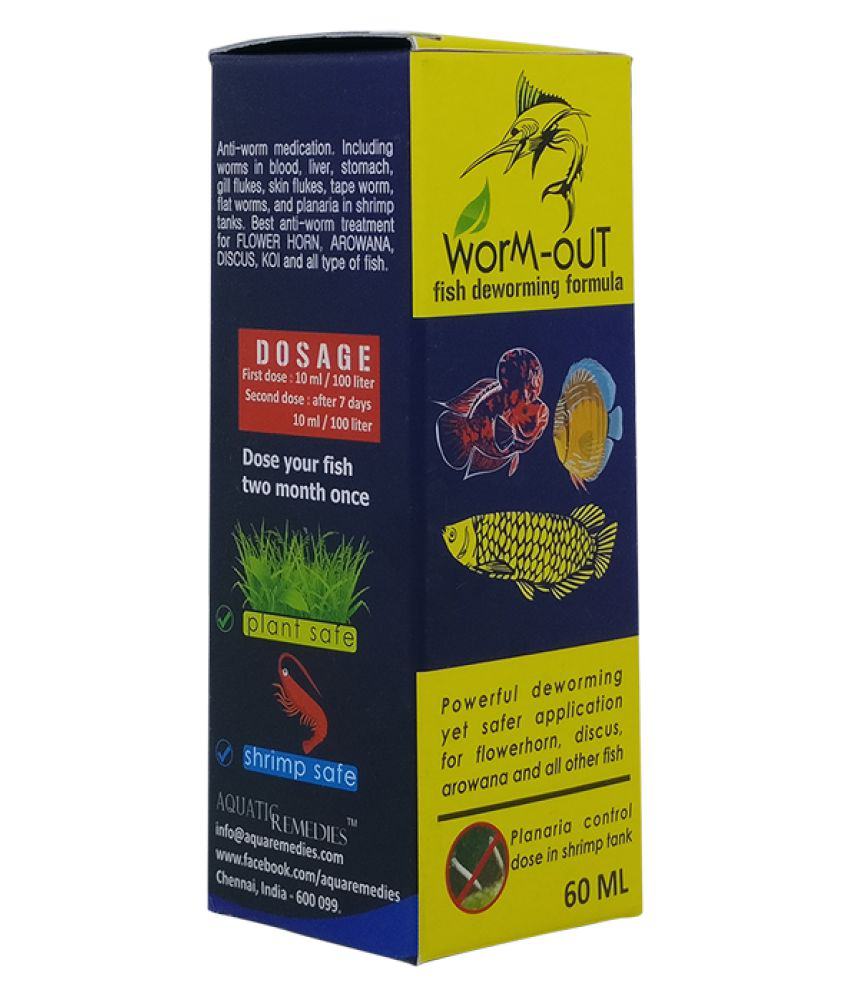
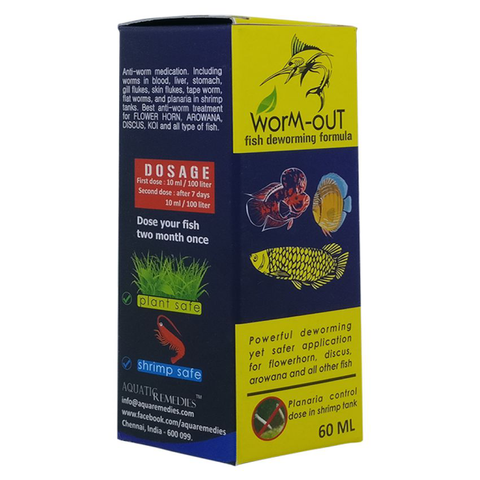
About & Origin
Worm-Out is a de-worming formula for freshwater aquarium fish, targeting internal worm parasites (such as intestinal roundworms and tapeworms) that live inside a fish rather than attaching to the outside of its body.
Internal worm infections are notoriously easy to miss — a fish can be carrying a real parasite load while still eating normally, and the more obvious signs (a thin, wasted-looking body despite a healthy appetite, stringy white faeces, or a swollen abdomen) often only appear once the infection is fairly established.
It's commonly used both as an active treatment once worms are suspected, and as a routine precaution for newly acquired fish — particularly wild-caught or farm-raised stock, which are more likely to arrive carrying internal parasites than long-established captive-bred fish.
Internal worm parasites don't always originate from another fish -- some enter through live or frozen foods (bloodworms, tubifex) sourced from the wild, which is one reason even a tank with no new fish added in a long time can still occasionally need deworming, particularly if it's regularly fed live/frozen foods rather than only prepared pellets/flakes.
Because internal parasites are essentially invisible without a microscope, many keepers treat as a precaution on a set schedule (for example, every few months) rather than only reacting once symptoms are already visible.
Requirements
Filtration: remove activated carbon before dosing, as it will absorb the medication.
Signs to watch for: a fish eating well but staying thin, stringy or white faeces, or a visibly swollen belly are the classic reasons to reach for a dewormer.
Quarantine use: many keepers run a deworming course as a standard part of quarantining new fish, before they ever join the main display, precisely because internal parasites aren't always visible on arrival.
Mixed tanks: as with most internal treatments, take extra care around invertebrates in the display — dose a separate quarantine/hospital tank if you're not confident about compatibility.
Confirming the problem: a fish eating well but staying thin over several weeks, alongside stringy or unusually pale faeces, is a reasonably strong combination of signs pointing to internal parasites specifically, as opposed to a water-quality or general-health issue.
Course length matters more than a single dose: deworming treatments are formulated around a repeat-dose schedule for a reason — most internal worm parasites have a life cycle stage that isn't affected by the active ingredient, so a single treatment can knock back the adult worms while leaving eggs or larvae to re-establish the infection days later. Following the full printed course, not stopping as soon as symptoms seem to improve, is what actually breaks that cycle.
Livestock-specific caution: scaleless and thin-skinned fish (many loaches and some catfish) and most invertebrates (shrimp, snails) tend to tolerate general medications less well than scaled fish -- if the tank being treated has either, dosing a separate hospital/quarantine tank rather than the full display is the safer route until you've confirmed the specific product is fine for them.
Compatibility

Dosage & Usage Guidelines
Follow the ratio and repeat-dose schedule printed on the bottle — deworming treatments are usually most effective as a short repeated course rather than a single dose, since it needs to catch the parasite's life cycle.
- Filtration: remove carbon media before dosing
- Good candidate for: new-fish quarantine, or a fish eating well but staying thin/losing condition
- Storage: cool, dark place, tightly sealed
- Follow-up: a partial water change after the course helps clear the tank
- Can be introduced via live/frozen foods, not only new fish
- Strongest signal: eating well but staying thin, combined with abnormal faeces
Repeat the course again a few weeks later if you're treating a fish sourced from live/frozen foods regularly, since re-infection is possible if the food source itself carries parasite eggs.
Shelf life and expiry: like most liquid aquarium medications, the active ingredient can lose potency over time even in an unopened, properly stored bottle — check the printed date before dosing an older bottle that's been sitting in a cupboard for a year or more, since an expired or degraded dose may under-treat the infection without you realising it failed.
Not a substitute for diagnosis: if a fish is losing condition but the classic worm signs (stringy/white faeces, swollen belly despite normal eating) aren't clearly present, it's worth ruling out a water-quality problem or a different illness first rather than reaching for a dewormer by default -- treating the wrong problem wastes the course and delays the fish getting what it actually needs.