About & Origin
The rainbow shark (Epalzeorhynchos frenatum) is a freshwater cyprinid from the Mekong and Chao Phraya river basins of Thailand and Cambodia, not a true shark at all -- the name comes from its torpedo-shaped body and tall, shark-like dorsal fin. In the wild it lives in fast-flowing, well-oxygenated rivers and streams over rocky or sandy substrate, grazing algae and biofilm off stones.
In the tank it keeps its bold silhouette: a dark grey-to-black body set off by bright red-orange fins. It's an active, inquisitive fish that spends most of its time patrolling the lower and middle levels, and it claims a favourite cave or piece of driftwood as a territory it will defend.
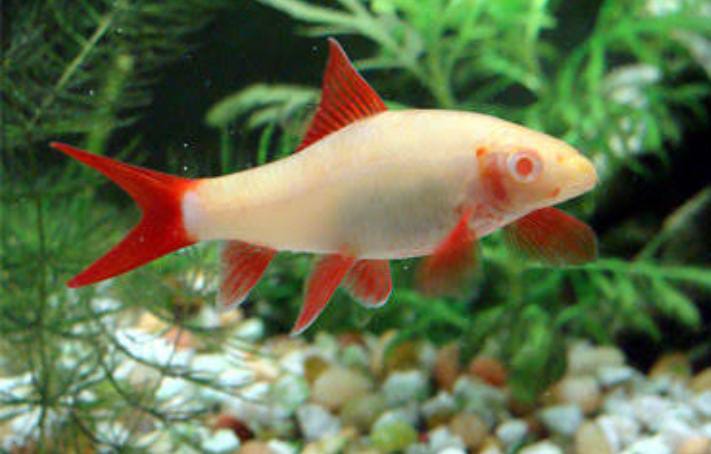
Wild colouration has largely been replaced in the trade by captive-bred stock, which tends to be a little hardier and more consistently coloured than wild-caught imports used to be. This albino form keeps the same body shape and temperament as the standard grey-and-red rainbow shark, but lacks dark pigment entirely -- the body is pale pink-white with the same bright red-orange fins, and the eyes are typically pink or red rather than black, a cosmetic strain produced by selective breeding rather than a different species.
It's frequently confused in shops with its close relative the red-tail shark (Epalzeorhynchos bicolor), which has a solid black body and only a red tail rather than all-red fins -- the two are separate species with very similar care needs but the red-tail shark is, if anything, even more intolerant of its own kind and lookalikes. With good care a rainbow shark can live 6-8 years, considerably longer than many of the small community fish it's often sold alongside, so it's worth planning tank space with that lifespan in mind rather than treating it as a short-term addition.
Requirements
A single rainbow shark does best in at least a 55-75 litre (15-20 gallon) tank with plenty of rockwork, driftwood, and plants to break sightlines and give it a defensible territory -- without enough visual cover it tends to patrol the glass and harass tankmates more than it otherwise would. A soft sand or fine gravel substrate suits its bottom-grazing habit better than sharp, coarse gravel, which can wear down its barbels and belly over time.
This is a territorial fish, and that territoriality is strongest towards its own species and towards other bottom-dwelling, similarly shaped or similarly coloured fish -- red-tail sharks, other rainbow sharks, and to a lesser extent bala sharks or large barbs can all trigger aggression. Two rainbow sharks in the same tank will almost always fight, often seriously, so they're sold and kept as a single specimen per aquarium; a tank that's too small or too sparsely decorated makes this worse, not better, since the fish has nowhere to retreat to when it loses a stand-off.
It's an omnivore in the tank -- sinking wafers and pellets as a staple, topped up with algae wafers, blanched vegetables (courgette, cucumber, blanched spinach), and occasional live or frozen food like bloodworm or brine shrimp for variety. It's not a fussy eater and grows quickly on a varied diet, typically reaching 12-16cm within its first one to two years, after which growth slows considerably.
Rainbow sharks are also capable jumpers, particularly when young or when first settling into a new tank, so a well-fitted lid is worth having regardless of how full the tank is kept. They're generally hardy once established, but like most cyprinids they're sensitive to sudden swings in water chemistry, so gradual acclimation when introducing them and stable parameters afterward matter more to this species than to some of the more forgiving community staples.
Compatibility

Water & Care Conditions
This is an active, oxygen-loving river fish, so water quality and flow matter more to it than to many slower-moving community species. Coming from fast-flowing water in the wild, it's noticeably more sensitive to poor water quality and ammonia/nitrite spikes than many hardier community fish, despite often being marketed as a beginner species:
- pH: 6.5–7.5
- Water hardness: soft to moderately hard, roughly 5–15 dGH
- Temperature: 22–26°C (72–79°F)
- Oxygenation: comes from fast, well-oxygenated rivers in the wild -- appreciates good flow and surface agitation from a filter outlet or powerhead
- Ammonia/nitrite: should always read zero; this species shows stress (colour loss, clamped fins, hiding) earlier than many tankmates when water quality slips
- Water changes: weekly partial water changes of 20-30% help maintain the stable, low-nutrient conditions this river species is adapted to
- Filtration: a filter rated for at least the tank's full volume, ideally with some extra turnover for the current it appreciates
Given stable conditions and a large enough territory, rainbow sharks are otherwise a low-maintenance, disease-resistant fish -- most health problems seen in the trade trace back to overcrowding or being paired with a similar-looking tankmate it never stops fighting with, rather than to the species being delicate. Like most scaled freshwater fish they're susceptible to ich (white spot disease) if stressed or chilled, and to fin damage from territorial disputes, but they don't have the scaleless-skin sensitivity to medication that catfish and loaches do, so standard treatments are generally safe to use if needed.
Albino rainbow sharks in particular, lacking dark pigment, can be slightly more light-sensitive than the standard colour form -- moderate rather than very bright tank lighting, with some shaded areas from plants or decor, tends to suit them better and keeps colours looking their best rather than washed out.