About & Origin
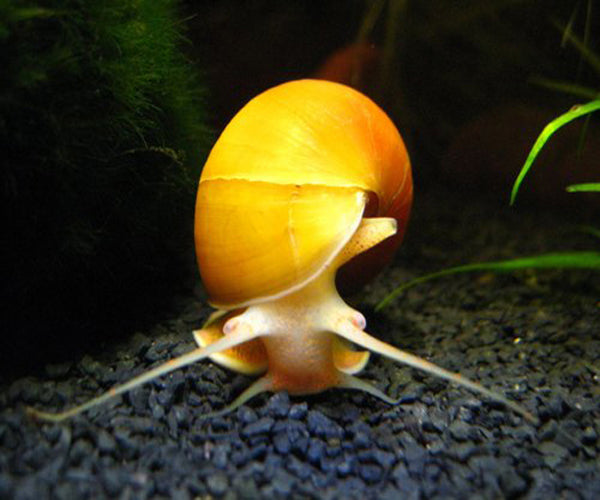
Apple snails (genus Pomacea) are large freshwater snails native to South America and parts of Central America, where they live in slow-moving rivers, ponds, marshes, and rice paddies. In the wild they graze on soft aquatic vegetation, algae, and decaying plant matter, using a broad muscular foot to glide across surfaces and a siphon-like breathing tube that lets them surface for air, since they possess both gills and a primitive lung.
They are among the largest commonly kept aquarium snails, with some varieties reaching golf-ball size or larger at full maturity. Shell colour and pattern vary widely between individuals and strains — yellow, brown, blue, and banded forms are all common in the trade, though colouring is largely genetic variation within the same handful of species rather than distinct "breeds."
Apple snails are popular for their bold size, active grazing behaviour, and personality — many keepers find them far more visibly interactive than smaller snail species, since they will readily explore glass, decor, and plants in search of food, and can often be seen using their long, mobile siphon to test the air above the waterline.
This combo listing supplies multiple apple snails at once, which suits keepers wanting a small cleanup crew or breeding group from the outset rather than starting with a single individual.
Apple snails are surprisingly long-lived for an invertebrate this size, with a typical lifespan of one to two years and some individuals living longer in stable, well-fed conditions — considerably longer than many people expect from a snail. They are dioecious (separate male and female individuals, unlike many other freshwater snails which are hermaphroditic), and a mixed-sex combo group will reproduce given the chance, laying the species' characteristic bright pink or orange egg clutches just above the waterline, which then hatch into fully-formed miniature snails after a few weeks.
Requirements
Apple snails need more swimming and grazing room than their slow pace suggests, since adults get genuinely large — a single snail is comfortably housed from around 20 litres upward, and a multi-snail combo like this one benefits from proportionally more space and surface area, both for bioload and because several large snails foraging at once produce a fair amount of waste.
An important, often-overlooked requirement: apple snails will readily eat soft, delicate live plants (Amazon swords, most stem plants) as part of their normal grazing, so they are a poor match for a heavily planted tank of tender species — tougher plants like Anubias and Java Fern, or a plant-free setup, work far better.
A secure, gap-free lid is genuinely necessary, since apple snails are capable and motivated climbers/escape artists and can survive out of water for surprising stretches; an unguarded tank is a common way to lose them.
Diet should include sinking algae wafers, blanched vegetables (courgette, cucumber), and calcium supplementation (cuttlebone or a mineral-rich substrate) to keep the shell strong and prevent pitting or erosion, which is one of the more common health issues in captivity.
Because this is a multi-unit combo, keepers should be prepared for the possibility of breeding — apple snails lay conspicuous pink/orange egg clutches above the waterline, and unmanaged colonies can grow quickly if clutches aren't removed.
Water changes matter more for a multi-snail combo than for a single specimen, simply because of the combined bioload — several large, actively grazing and excreting snails in one tank will raise nutrient levels faster than a single individual, so keeping an eye on ammonia/nitrite and maintaining a normal water-change schedule is worth building into routine maintenance from the start.
Compatibility
Water & Care Conditions
Apple snails are fairly adaptable, but keeping them within a sensible range avoids shell damage and keeps them active:
- pH: 7.0–8.0 — slightly alkaline water helps the shell stay strong; soft, acidic water gradually erodes and pits the shell over time
- Hardness: moderate to hard water (8–20 dGH); very soft water is a real long-term problem for shell health
- Temperature: 22–28°C (72–82°F), typical community tropical range
- Oxygenation: not demanding, since apple snails can breathe atmospheric air via their siphon, but good surface movement still benefits any fish sharing the tank
- Water quality: sensitive to copper-based medications, which are toxic to snails and all invertebrates — never dose copper treatments in a tank housing apple snails
- Substrate/calcium: a mineral-rich or crushed-coral substrate gently buffers hardness upward over time and supplies extra calcium for shell growth, on top of dietary supplementation
Regular partial water changes and stable parameters go a long way toward preventing shell pitting and keeping this combo's snails active and visible.
One practical note specific to a multi-unit purchase like this: if the group turns out to be mixed-sex (which is common, since sexing juvenile apple snails visually is unreliable), expect egg-laying within weeks of settling in — clutches can be left to hatch if a growing colony is welcome, or removed and discarded before hatching if population control matters to the keeper.
Because this combo pack contains multiple large snails, keep an eye on bioload as they mature — a filter sized generously for the tank's overall volume, combined with regular gravel vacuuming under and around decor (where waste tends to collect), keeps water quality stable as the group grows and feeds.
Test kits for pH and general hardness are worth keeping on hand specifically for this species, since shell condition is one of the clearest visible signals of whether the water chemistry is actually suiting the snails, well before other tankmates would show any obvious stress.