About & Origin
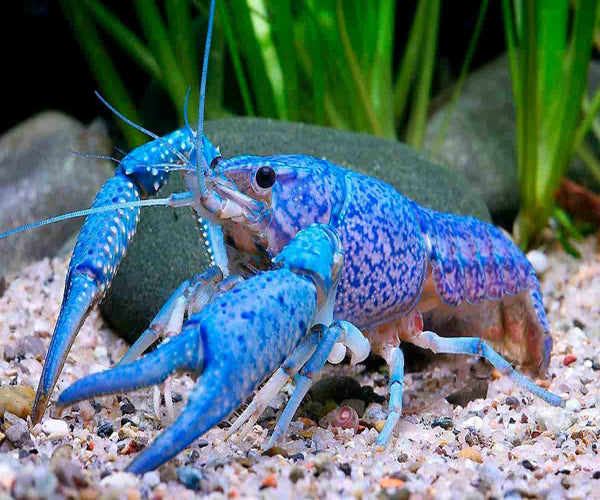
Freshwater "lobsters" sold in the aquarium trade, including this Blue Lobster, are almost always crayfish (family Cambaridae) rather than true lobsters, which are exclusively marine. This vivid electric-blue colouration is most commonly associated with Procambarus alleni, a crayfish native to the freshwater marshes, ditches, and slow streams of Florida, USA.
It's a striking, hardy, and surprisingly intelligent invertebrate — an active digger and forager that will rearrange its tank's décor to suit itself, build burrows, and investigate anything new with its claws.
Like all crayfish, it grows by moulting its exoskeleton periodically, appearing pale and vulnerable for a short time after each moult before the new shell hardens.
Unlike many "colour morph" aquarium animals bred specifically for an unnatural hue, electric blue is actually the natural wild-type colouration for Procambarus alleni in parts of its native range -- a genuine, if striking, colour this species shows in the wild rather than a result of selective aquarium breeding. Adults typically reach 10-13cm (4-5 inches) body length, with large, prominent claws used both for defence and for manipulating food and décor. Lost limbs, including claws, regenerate over successive moults, a genuine advantage this species has over most fish when it comes to recovering from injury.
Requirements
Freshwater crayfish have a few needs that are quite different from typical community fish.
Tank size: at least 20–30 gallons (75–115L) for a single adult, with a secure, tight-fitting lid — crayfish are capable climbers and escape artists.
Housing: best kept alone or in a species-only setup. Multiple crayfish in one tank can fight, especially over hiding spots or during moulting, and territorial disputes can be serious, sometimes resulting in lost limbs or worse.
Décor & hiding spots: provide caves, driftwood, or clay pots to dig around and hide in — crayfish are natural burrowers and feel more secure with cover.
Diet: omnivorous scavengers — sinking pellets, blanched vegetables, and occasional protein, plus a calcium source to support healthy moulting and shell strength.
Escape risk: crayfish are strong, persistent climbers and will exploit any gap in a lid, filter opening, or cord hole -- a genuinely secure, gap-free lid is worth checking carefully rather than assumed adequate, especially since a crayfish found outside the tank can survive out of water for a surprisingly long time.
Plants: expect this species to dig up, clip, and eat soft-leaved live plants -- tough, well-anchored species (Anubias, Java Fern tied to wood/rock) survive better than delicate stem plants in a crayfish tank.
Compatibility
Water & Care Conditions
Freshwater crayfish are tolerant of a range of conditions but do best within these ranges:
- pH: 7.0–8.0, kept as stable as possible
- Water hardness: moderately hard water with good mineral content, which supports healthy shell/exoskeleton development
- Temperature: 20–24°C (68–75°F) — notably cooler than most tropical community fish; does not need a heater in most rooms
- Oxygenation: appreciates well-oxygenated water; avoid low-oxygen, stagnant conditions
Stability matters more than an exact number — sudden swings in parameters are harder on a crayfish during and right after a moult, when it's temporarily soft-shelled and vulnerable.
Weekly partial water changes and a properly cycled filter keep ammonia and nitrite in check -- crayfish are sensitive to poor water quality despite their tough appearance, and produce a fair amount of waste for their size relative to a typical community fish. Avoid copper-based medications entirely, as with all crustaceans, since copper is highly toxic to them even at doses considered safe for fish.
Well-kept individuals typically live 2-3 years, sometimes longer, with colour remaining vivid throughout life provided diet and water quality stay consistent. A dulling shell colour between moults is usually normal and typically resolves fully once the next successful moult completes and the new shell settles in.