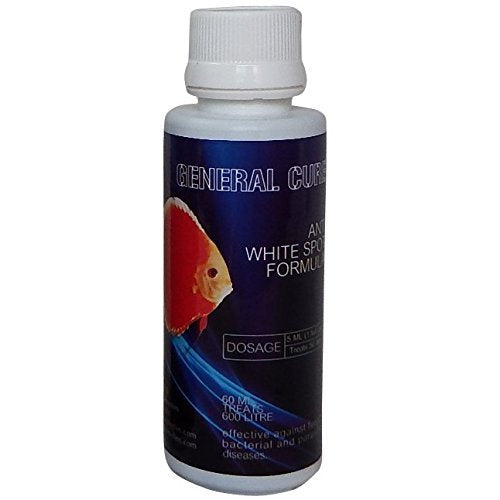
About & Origin
General Cure is a multipurpose, broad-spectrum treatment for freshwater aquarium fish, built to cover parasitic, bacterial, and fungal problems with a single product rather than needing a different bottle for every symptom.
Products in this category typically combine an anti-protozoan agent with a deworming agent, giving them a wide reach across common problems like Ich, gill and skin flukes, internal worms, and some of the milder bacterial and fungal issues that often show up alongside a parasite outbreak.
It's a popular first-response medicine precisely because aquarium diseases are often hard to tell apart with certainty at home — a fish that's flashing, clamping its fins, and looking off-colour could be dealing with any of several different problems, and a broad-spectrum remedy gives you a reasonable first line of defence while you watch how it responds.
Because it's genuinely broad-spectrum, General Cure is one of the few products that makes sense to reach for even before you're sure exactly what's wrong -- most narrower treatments (a pure antifungal, a pure external parasiticide) work best once you have a reasonably confident diagnosis, whereas a broad-spectrum remedy gives useful coverage across several possibilities at once while you observe how the fish responds.
The active-ingredient combination typically used in this category (an anti-protozoan agent paired with a dewormer) is chosen because these two classes of problem — protozoan parasites and internal worms — are both extremely common in aquarium fish and often present with overlapping, hard-to-distinguish symptoms: reduced appetite, clamped fins, a generally "off" look, and sometimes visible spots or stringy waste. Rather than guessing between several narrow products, a combination remedy covers both bases in one course, which is a large part of why this type of product has become a standard first-response item in most fishkeepers' medicine cabinets.
Requirements
Because General Cure is broad-spectrum, it's often used both as an active treatment and as a preventive measure — for example when adding new fish, during quarantine, or after a stressful event like a big water change or a move.
Filtration: remove carbon from your filter before dosing; it will absorb the medication and reduce its effectiveness.
Dosing: a typical broad-spectrum course is dosed, followed by a wait period, then a partial water change — check your bottle's specific schedule, as courses are usually repeated rather than a single dose.
Safe for freshwater use; as with most parasite/bacterial treatments, take extra care with invertebrates and scaleless fish, and treat those in a separate tank if you're not confident the product is safe for them.
It pairs well with a quarantine routine for new arrivals — many keepers run a course of a broad-spectrum remedy like this during the first couple of weeks a new fish is in the house, before it ever reaches the main display.
Quarantine standard: many experienced keepers treat every new fish with a broad-spectrum remedy like this during a 2-4 week quarantine period before it ever joins the main display, specifically because it's difficult to be certain a new fish is disease-free just from a visual check at the shop.
After a stressful event: beyond new arrivals, a course is also commonly used after anything that meaningfully stresses a fish's immune system — a long shipping delay, a sudden temperature swing, an aggressive tankmate, or a major water-quality lapse — since stressed fish are considerably more susceptible to opportunistic parasites and infections in the days that follow.
Not a substitute for good husbandry: even a reliable broad-spectrum remedy works best as a backstop, not a replacement for regular water changes, sensible stocking density, and quarantining new arrivals — a tank that's already well-maintained will generally need this kind of treatment far less often than one that isn't.
Compatibility

Dosage & Usage Guidelines
Follow the dosing schedule on the bottle — broad-spectrum treatments like this are generally applied over a multi-day course, not as a single dose.
- Filtration: remove carbon before dosing
- Typical use cases: unclear/mixed disease symptoms, new-fish quarantine, post-stress prevention
- Caution: take extra care with shrimp, snails, and scaleless fish — treat separately if unsure
- Storage: cool, dark, tightly sealed
- Follow-up: a partial water change at the end of the course helps clear the tank
- Especially suited to: new-fish quarantine and situations where the exact problem isn't clear yet
- Freshwater use as with the rest of this product family
- Preventive use: a light course after adding new fish or after a stressful event can head off a problem before visible symptoms appear
- Complete the course: stopping early once a fish "looks better" can leave surviving parasites/organisms behind to rebound
- Combine with observation: keep a simple log of appetite/behaviour during treatment so you can judge whether it's genuinely working
- Keep out of reach of children and pets, and away from direct sunlight or heat sources that can degrade the active ingredients
Because it's broad-spectrum rather than narrowly targeted, expect a somewhat longer response time than a treatment aimed at one specific, correctly-diagnosed problem -- give it the full recommended course before concluding it isn't working. If symptoms are still present after a complete course, that's a sign the problem may need a more targeted product rather than a second round of the same broad-spectrum treatment. As always with aquarium medication, keep it well out of reach of children and pets, and avoid letting it sit in direct sunlight or a hot spot near a window, which can degrade the active ingredients over time and shorten its effective shelf life.