About & Origin
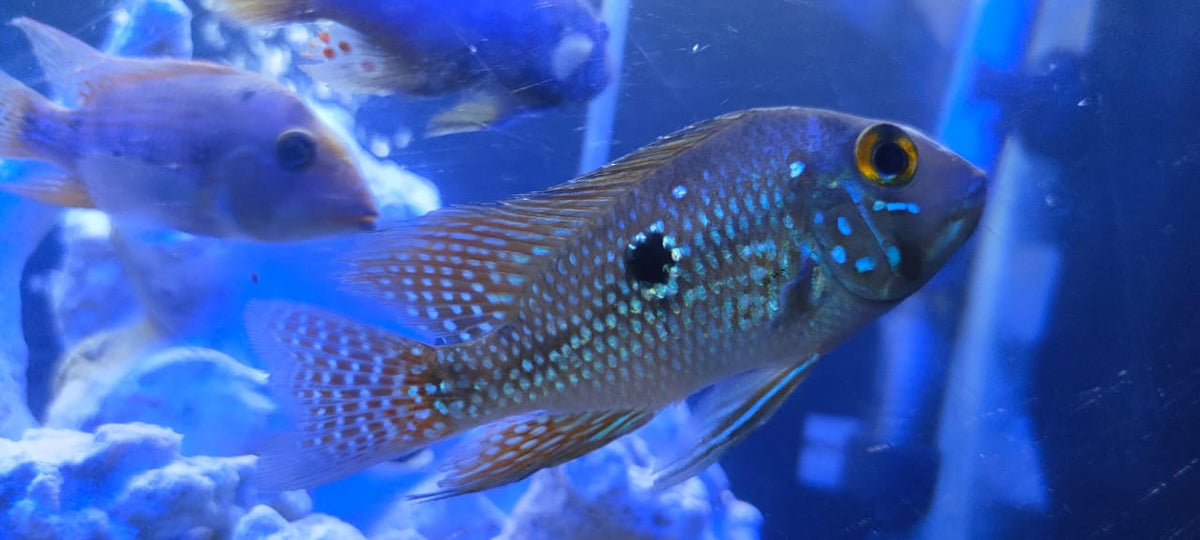
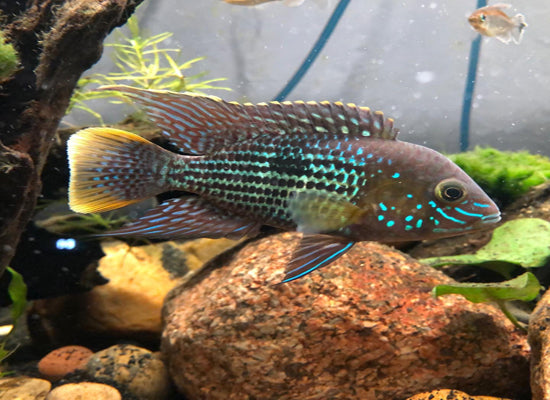
The Pearl Cichlid (Geophagus brasiliensis) is a South American "eartheater" — a large family of cichlids named for their habit of sifting mouthfuls of substrate through their gills to filter out edible invertebrates, then spitting the rest back out. It's native to coastal rivers and lakes across a wide stretch of eastern Brazil and Uruguay, one of the most adaptable and widely distributed Geophagus species as a result.
Adults display a striking pattern of iridescent blue-green spangling across a pearly body, especially vivid under good lighting, and can reach a substantial 25–28 cm (10–11 inches) — considerably larger than many of the more compact eartheater species kept in the hobby.
Compared to the African rift lake cichlids on this list, Geophagus is a completely different water-chemistry world: a soft, neutral-to-slightly-acidic South American species, not a hard-alkaline African one — the two groups should not be mixed in the same tank.
The "eartheater" feeding style is worth watching closely once settled in: a Pearl Cichlid will patrol the substrate methodically, taking a mouthful of sand, sifting it through comb-like gill rakers to extract worms, insect larvae, and other edible matter, then expelling the cleaned sand a short distance away. Over time this constant activity subtly reshapes the substrate into small mounds and craters, which is entirely normal behavior rather than a sign of an unhappy fish.
Compared with many other Geophagus species, brasiliensis is unusually tolerant of temperature swings and slightly cooler water, which — combined with its wide natural range along the Brazilian and Uruguayan coast — has made it one of the hardier, more beginner-accessible eartheaters, even though it still isn't a true beginner cichlid given its eventual size.
Requirements
This item is sold at 2–3 inches, but plan ahead: adults need 300+ litres (75+ US gallons) given their size and constant sand-sifting activity.
Temperament: generally peaceful for a cichlid of its size, though it can be territorial with its own kind and should be kept with similarly-sized, non-nippy tankmates rather than small fish. Unlike many Central American or African cichlids, Geophagus rarely dig up or destroy plant roots aggressively, making it one of the more plant-tank-compatible larger cichlids provided the plants are in pots or otherwise protected from the sifting substrate.
Diet: omnivorous — sinking cichlid pellets as a staple, with live or frozen food (bloodworm, brine shrimp, chopped prawn) appreciated; feeding should account for its constant sand-sifting, which burns real energy, so this is not a species to underfeed relative to its activity level.
Décor: fine sand substrate is important — coarse gravel can damage the delicate gill rakers this species relies on to sift food; open sand areas plus some rockwork or driftwood for cover. Leave generous open floor space rather than filling the tank with décor, since sifting behavior needs room to happen naturally.
Social structure: does best kept in a small group of five or more to diffuse aggression through a natural pecking order, rather than as an isolated pair, which can otherwise concentrate territorial behavior on a single unlucky tankmate.
Breeding: Geophagus brasiliensis is a substrate-spawning biparental mouthbrooder in many populations — pairs lay eggs on a flat surface, and once hatched, both parents take the wrigglers into their mouths for a period before releasing a free-swimming brood that continues to shelter in a parent's mouth at the first sign of danger for some weeks. It's genuinely engrossing parental behavior to watch if a compatible pair forms in a home aquarium, though breeding isn't guaranteed and isn't the reason most keepers choose this species.
Growth rate: reasonably fast for a large cichlid when well-fed on a varied diet in warm, clean water, though final adult size and the depth of colour still take a year or more of maturity to fully develop.
Compatibility
Water & Care Conditions
A soft, neutral-water South American species — do not house with hard-alkaline African rift lake cichlids, whose water needs are essentially the opposite:
- pH: 6.5–7.5
- Water hardness: soft to moderate, roughly 5–8 dKH
- Temperature: 24–27°C (75–81°F), though this species tolerates cooler water (down to ~20°C) better than most tropical cichlids
- Oxygenation: standard filtration; not an especially demanding species on this front
- Substrate depth: a few centimetres of fine, rounded sand is enough to support natural sifting behavior without becoming compacted or anaerobic underneath
Fine sand substrate matters as much as water chemistry here — it's a functional need for feeding, not just aesthetics. Regular gentle stirring during water changes (or letting the fish do it themselves) helps prevent pockets of trapped waste from building up in deeper substrate.
Water changes of 20-25% weekly keep nitrates in check for a fish this size and this active; because Geophagus produce a fair amount of waste relative to their omnivorous diet, undersized filtration is one of the more common reasons keepers see cloudy water or stalled growth. A mature, well-maintained tank with stable soft-to-neutral parameters will reward this species with excellent colour and a long, healthy lifespan well into double digits.
Unlike African rift lake species that actively benefit from harder, more mineral-rich water, Geophagus brasiliensis should never be kept in water buffered with crushed coral or similar alkaline substrates — doing so pushes pH and hardness in exactly the wrong direction for this species and can cause chronic low-grade stress even if the fish doesn't show acute symptoms right away. If your tap water is already hard and alkaline, this is one of the reasons to choose an African cichlid instead, rather than trying to force a South American species into the wrong chemistry.