About & Origin
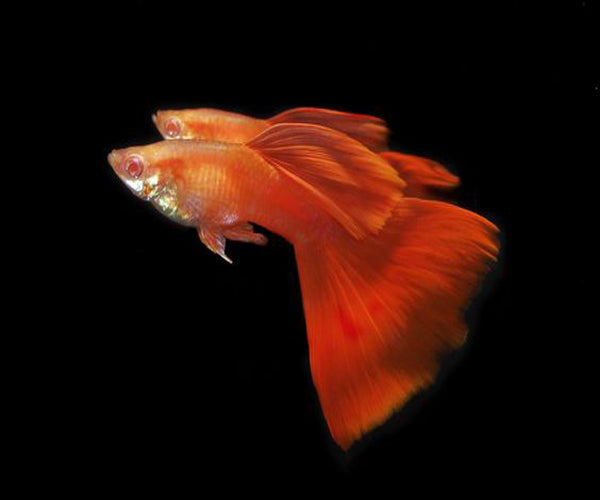
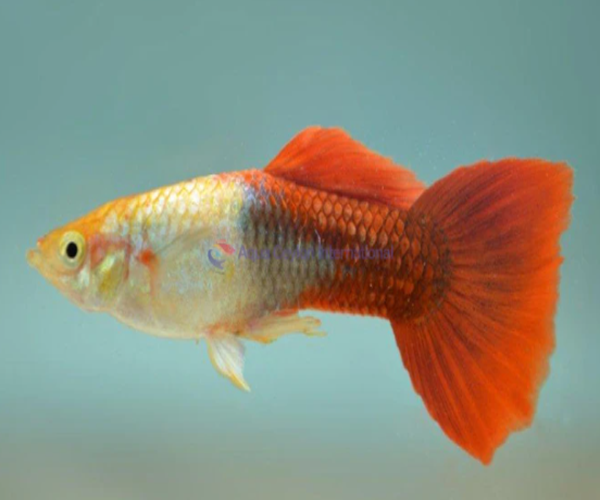
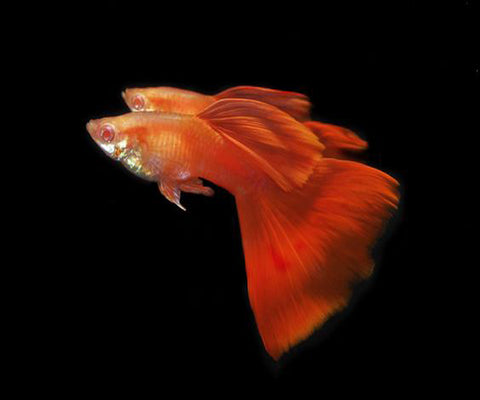
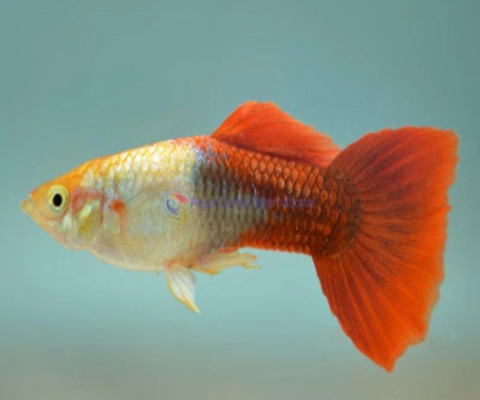
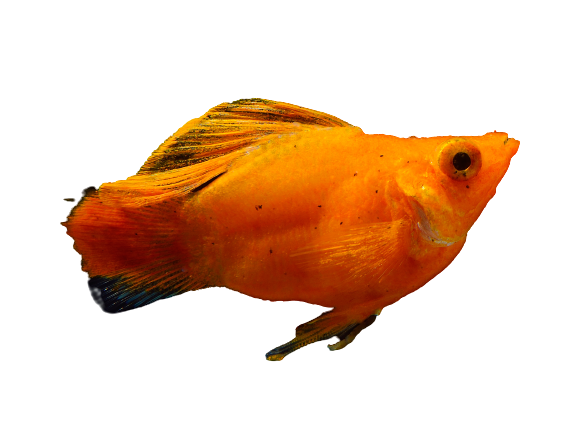
The Golden Red Guppy is a fancy guppy strain (Poecilia reticulata) bred for a warm golden-red body color. Wild guppies originate from streams, ponds, and coastal waters across Venezuela, Trinidad, Guyana, and northern Brazil, and this strain is a purely ornamental color selection from that same adaptable species.
In the wild, guppies live in shallow, warm, often nutrient-rich water and are famous among biologists for how fast they adapt to local conditions — including to predators, which has made them one of the most studied fish in evolutionary biology. In the aquarium hobby, that same adaptability is exactly what makes guppies such a reliable beginner fish.
"Golden" in guppy breeding refers to a specific, well-documented body-color gene that lightens the fish's base body tone from the dark grey of wild-type guppies to a warmer bronze-gold, by reducing the density of black melanophore pigment cells across the body. Paired here with red patterning genes, the result is a guppy whose whole body reads warm gold-to-copper rather than the cooler silvery-grey background seen on plainer strains, letting the red finnage and body markings stand out more sharply against it. Guppy pattern and color genes are largely sex-linked (carried on the Y chromosome, inherited mostly father-to-son), which is part of why a breeder can hold a strain like this consistent across generations by selecting which males are bred forward.
Golden-bodied guppies also tend to show their color a little differently as they mature: young fry and juveniles often look plainer, with the full golden-red contrast only really coming in once the fish reaches adult size and finishes coloring up over its first few months, so patience is worth having with recently arrived young stock.
The Golden Red Guppy strain sold here is bred and raised for the aquarium trade specifically for its coloring and finnage; its care, temperament, and water needs are identical to any other guppy variety.
fishykart.com ships healthy, actively-colored stock, not fish pulled straight from a wholesale feeder tank.
Requirements
Standard guppy husbandry applies (10 gallon/38 litre minimum for a group of 6+, roughly 2 litres per adult, female-heavy sex ratio, omnivorous flake/micro-pellet diet with occasional brine shrimp or daphnia, floating or fine-leaved plants for fry cover, a tight lid since they jump, fry every 4-6 weeks once mature).
This strain specifically: the golden-red colouring is diet- and light-sensitive in how vivid it looks — a colour-enhancing food (carotenoid-rich flake, occasional brine shrimp) noticeably deepens the red tone over a few weeks, while a plain flake-only diet tends to leave it looking flatter and more orange than red. Warm-spectrum lighting also brings out more red than a cool blue-white LED setting does. Finnage is standard, not exaggerated, so it's not especially fin-fragile compared to fancier-finned strains.
Tank setup for colour: a darker substrate and background generally makes the gold-red tone read more vividly by contrast, the same principle used for most brightly coloured fish -- a stark white-gravel tank tends to wash out warm colours under typical lighting.
Sex ratio and breeding: as with any guppy, run a female-heavy or female-only group to avoid over-harassment if you're not planning to breed; males show the fullest golden-red colouring, while females carry a much subtler version of the same base colouring.
Group size: keep in a shoal of 6 or more -- guppies are genuinely social and a lone individual, regardless of colour strain, is both more stressed and less visually striking than one displayed as part of an active group.
Diet frequency: feed small amounts 1-2 times daily rather than one large feeding -- guppies have small stomachs and do better, both in condition and colour, on frequent modest meals than infrequent large ones, and uneaten excess simply fouls the water without benefiting the fish.
Compatibility

Water & Care Conditions
- pH: 6.8–7.8
- Salinity / hardness: freshwater, moderately hard (10–20 dGH)
- Temperature: 24–28°C (75–82°F)
- Oxygenation: moderate surface movement, nothing stagnant
Consistency beats precision — stable water a little outside these numbers is better than unstable water that's technically "correct." For this strain, a dulling or greying of the gold-red tone is often the first visible sign that something in the water has drifted, ahead of other symptoms.
Weekly 20-25% water changes support both colour and finnage, and cut down on fin rot/ich risk. Acclimate new fish slowly (20-30 minute drip) rather than releasing them straight into different water, since sudden parameter shock is a common cause of early losses.
This is captive-bred stock and generally copes with ordinary dechlorinated tap water once roughly in range. Well-kept guppies typically live 2-3 years.
Because colour intensity in this strain is closely tied to overall condition, a Golden Red guppy that suddenly looks pale or flat is worth treating as an early health check-in rather than dismissed as normal variation -- check ammonia and nitrite first, since a spike in either is one of the most common underlying causes of sudden colour loss in guppies generally, well before a fish shows more obvious signs of distress.
Avoid copper-based medications where possible, as with most ornamental fish, particularly if any invertebrates share the tank, and keep feeding varied rather than relying on a single food type long-term -- a mixed diet supports both general health and the carotenoid-driven colour this strain is specifically bred to show off. Fin and body condition should stay smooth and undamaged in a well-run tank; ragged edges or clamped fins point toward either a tankmate issue or a water-quality problem needing attention rather than something to wait out.