About & Origin
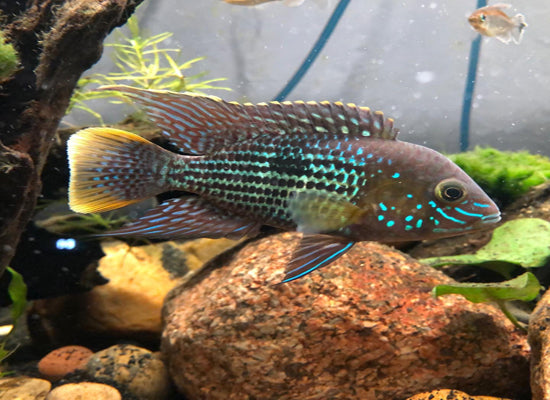
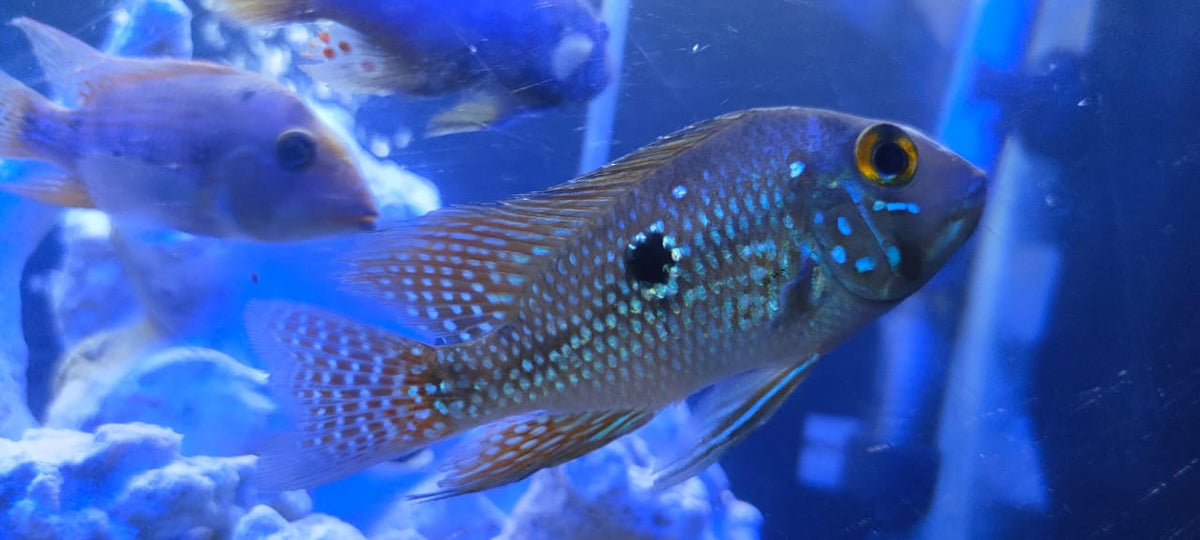
The Green Terror (Andinoacara rivulatus) is a South American cichlid from Pacific-slope rivers of Ecuador and Peru, named for its feisty temperament rather than any special ferocity beyond typical medium cichlid standards — "terror" is more hobby marketing than literal warning. Males develop a striking mix of turquoise-green spangling across the face and body with an orange-red edge to the tail fin as they mature, one of the more visually dramatic South American cichlids at an accessible size.
In the wild it inhabits a range of moving and still water, from rivers to lake margins, which contributes to its being a fairly adaptable, forgiving aquarium fish once past the juvenile stage.
Adults reach 20–30 cm (8–12 inches), with males growing a pronounced nuchal hump — a mid-large cichlid that needs real space by adulthood, though it starts out manageable as a juvenile.
Sexual dimorphism becomes obvious with age: males are larger, develop the trademark hump and longer trailing fin extensions, while females stay more compact and often show a darker, more solidly-coloured body. A related, closely similar species — the "Gold Saum" green terror — shows a bright gold-orange rim along the dorsal and tail fin instead of the standard red, and the two are sometimes confused or crossed in the trade, though enthusiasts generally prize keeping the lines distinct.
Juveniles are drab silvery-grey with faint vertical barring and give little hint of the adult's colour — the dramatic turquoise spangling is a gradual reward that typically doesn't fully emerge until the fish is six months to a year old and settled into stable, well-maintained water.
The species name honours its striking blue-green iridescence under aquarium lighting, which shifts noticeably depending on the light's angle and colour temperature — many keepers report their green terror looking almost drab under weak lighting and genuinely spectacular under a well-chosen full-spectrum LED, making lighting choice a real, practical factor in how much this fish's investment pays off visually.
Requirements
250+ litres (65+ US gallons) for an adult; this species outgrows small tanks quickly and becomes noticeably more territorial as it does.
Temperament: semi-aggressive to aggressive, particularly as it matures and especially if paired for breeding; best with similarly robust, similarly-sized South American cichlids and catfish rather than small or delicate tankmates. A single juvenile can often start out in a smaller community setup, but plan to rehome or upgrade well before adulthood as its territorial instincts sharpen.
Diet: omnivorous — a quality cichlid pellet plus occasional meaty frozen food (bloodworm, prawn, chopped earthworm); not a fussy eater, and appreciates variety to bring out its best colour.
Décor: rockwork and driftwood for territory and sightline breaks; this species will also rearrange substrate and uproot plants, so choose hardscape over a delicate planted layout. Secure any stacked rockwork firmly, since a determined adult can and will dig underneath and destabilise loosely arranged décor.
Breeding: forms a bonded pair that will select and clean a flat rock or excavate a shallow pit to spawn in, then both defend the brood fiercely — expect a breeding pair to become considerably more aggressive toward tankmates and even each other during courtship disputes before settling into cooperative parenting.
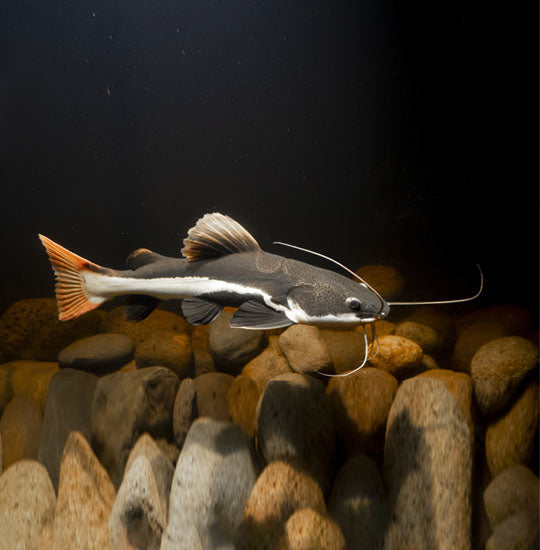
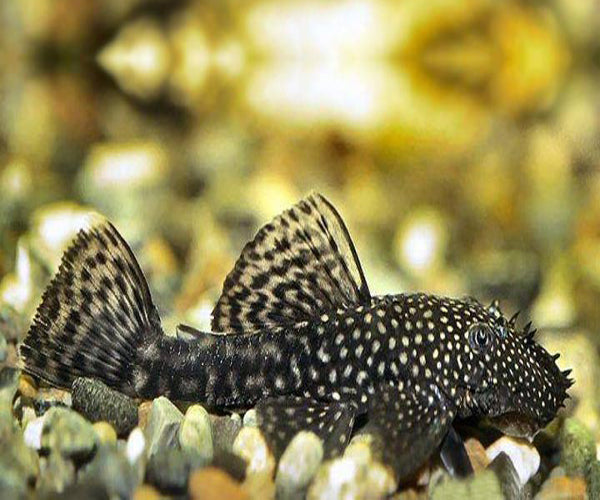
Compatible tankmates: larger, robust South American cichlids (severums, other medium Central/South American species), plecos, and larger tetras or silver dollars that can hold their own; avoid small livebearers, delicate tetras, and anything slow or long-finned that reads as easy prey or a rival to a maturing green terror.
Handling growth spurts: this species can grow quickly when well fed in a spacious, clean tank, so keepers who start with a small juvenile should have the eventual larger tank ready well before it's actually needed rather than scrambling to upgrade after the fish has outgrown its starter setup.
Compatibility
Water & Care Conditions
Softer and more neutral than the African rift lake species on this list:
- pH: 6.5–7.8
- Water hardness: soft to moderately hard, roughly 5–15 dGH
- Temperature: 22–26°C (72–79°F)
- Oxygenation: standard strong filtration; this is a large, waste-producing fish as an adult, so filtration capacity matters more than any special aeration need
- Water changes: 20-30% weekly is a reasonable baseline once adult, adjusted upward if the tank is heavily stocked or filtration is on the smaller side
Reasonably tolerant of normal tap water once established — the bigger factor with this species is usually tank size, not water chemistry precision. Green terrors handle a wider swing in hardness and pH than many South American cichlids, which is part of why they've become a popular "gateway" cichlid for keepers stepping up from community tanks without wanting to deal with the more demanding water requirements of, say, wild-caught discus or apistogramma.
That tolerance has limits, though: rapid temperature drops and poor water quality from an undersized filter are the two most common preventable causes of illness in this species, showing up as clamped fins, faded colour, or susceptibility to ich and fin rot. A stable heater and a filter rated well above the tank's minimum for its eventual adult bioload go a long way toward avoiding both.
Sudden pH crashes are worth guarding against specifically in soft-water setups without much buffering capacity — testing kH periodically alongside pH gives an early warning before a crash actually happens, since a tank with very little carbonate hardness can swing sharply after a build-up of organic waste between water changes. Consistency matters more than hitting an exact number — this species handles a wide window of pH and hardness far better than it handles frequent, sudden changes between two otherwise-acceptable values.