About & Origin
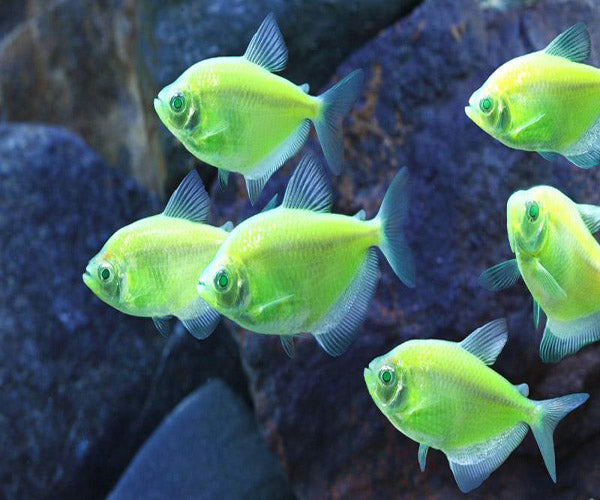
The "widow tetra" sold in colour variants like this green form is Gymnocorymbus ternetzi, the Black Widow Tetra (also called the Black Skirt Tetra), native to the Paraguay River basin across Paraguay, Argentina, and southeastern Brazil. The naturally occurring wild-type fish is smoky grey-black, fading from pale grey at the head to solid black across the rear half and long, flowing "skirt" fins.
Vivid colour variants like this green form are not a naturally occurring wild colour — they're typically produced either through dye injection or, less commonly, selective breeding of naturally occurring colour morphs, a practice worth being aware of, since the colouring is cosmetic and applied to a base fish that is otherwise the ordinary, hardy black widow tetra. Buyers who prefer a fish's natural, undyed appearance should look for the standard black or gold/white widow tetra forms instead.
Underneath the colouring, this is the same genuinely easy, hardy tetra species long popular in the hobby — active, shoaling, and notably less fussy about water chemistry than many other tetras, tolerating a wider pH and hardness range than soft-water specialists like cardinals or discus-tank tetras.
This combo pack supplies a starter shoal at once, matching how this naturally social, group-shoaling species should always be kept.
The undyed, naturally-coloured black form of this same species remains widely available and is worth considering as an alternative for keepers who'd prefer not to support the dyeing trade — it offers identical hardiness, shoaling behaviour, and ease of care, just without the added colour.
Regardless of colour form, adults reach around 5–6cm and are deep-bodied with a distinctive triangular "skirt" formed by the long anal and dorsal fins, giving the species its common name and a silhouette that reads unmistakably even at a glance across a busy community tank.
Requirements
Black widow ("skirt") tetras, including coloured forms like this one, should be kept in shoals of 6 or more — a lone or small group of 2-3 fish will be noticeably more nervous and prone to fin-nipping each other than a properly sized group, since much of their social/territorial energy gets redirected onto tankmates otherwise.
A tank of at least 60 litres suits a shoal of this size comfortably, with a mix of open swimming space and planted cover; floating plants are appreciated and help shy or newly-settled fish feel secure.
This species has a well-known reputation for nipping the fins of slow-moving, long-finned tankmates (bettas, fancy guppies, angelfish) — a real consideration when planning tankmates, and one reason it's often better suited to an all-tetra/community tank without delicate long-finned fish.
Diet is easy: a good-quality flake or micro-pellet as a base, with occasional live or frozen foods (brine shrimp, daphnia, bloodworm) for variety and colour.
Because dyed fish can sometimes carry additional stress from the dyeing process itself, extra care during acclimation (slow drip acclimation, minimal handling) is worth taking with freshly purchased coloured widow tetras.
Providing plenty of plant cover and maintaining a properly sized shoal both genuinely help reduce this species' fin-nipping tendency toward tankmates, since a settled, secure group is measurably less prone to redirecting territorial or nippy behaviour onto other fish in the tank.
A tight-fitting lid is worth having, as with most active tetras, and a fully cycled tank before introduction matters — this species is hardy once established but, like any fish, is more vulnerable to ammonia and nitrite spikes during a brand-new tank's first weeks than once the biological filter has matured.
Because this combo pack supplies a full shoal at once, it's a genuinely good starter option for a first planted community tank — the group dynamic that keeps this species calm and colourful is present from day one, rather than needing to be built up fish by fish over time.
Compatibility
Water & Care Conditions
One of the real advantages of this species is genuine flexibility on water chemistry — it's one of the few tetras that will even breed in hard, alkaline water:
- pH: 6.0–7.5, and tolerant of a wider range than most tetras
- Hardness: soft to moderately hard (2–20 dGH) — unusually flexible for a characin
- Temperature: 20–27°C (68–81°F)
- Oxygenation: not demanding; moderate flow and normal community-tank filtration is sufficient
This genuine hardiness is a large part of why the species (in its natural and dyed colour forms alike) remains a long-standing beginner-friendly staple of the hobby.
This species will also breed readily in a well-maintained community tank given enough plant cover for eggs to fall into and hatch undisturbed, though as with most egg-scattering tetras, the parents will eat their own eggs and fry without dense planting or a dedicated breeding setup.
Regular partial water changes (around 20–25% weekly) keep nitrate in check and support the vivid colour this species is prized for, whether that colour is the natural black form or a dyed variant like this one — dull, washed-out colouring in an otherwise healthy-looking fish is often simply a sign that water quality has drifted and a change is overdue.
Because this species tolerates such a wide pH and hardness range, it's a genuinely forgiving choice for keepers whose tap water doesn't match the narrower requirements of soft-water specialist tetras, and it adapts well to whatever stable parameters a community tank happens to settle at.
This species is also notably tolerant of the lower end of typical tropical temperatures, making it one of the more forgiving shoaling fish for a community tank that runs slightly cooler than strict tropical setups, without needing special adjustment.