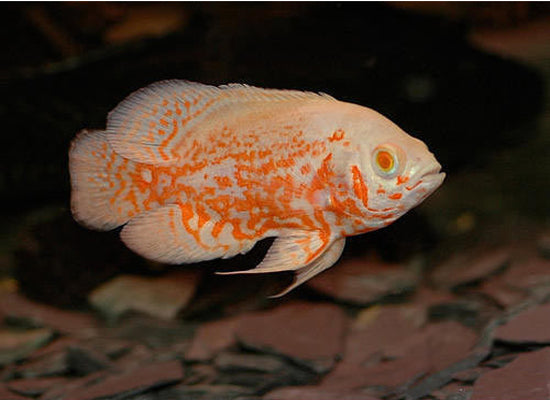
About & Origin
The Oscar is a large, intelligent South American cichlid (Astronotus ocellatus), native to the Amazon and Orinoco river basins, living in slow-moving, often turbid tributaries and floodplain waters. The Mango Oscar is a selectively bred colour variety showing warm orange-yellow tones reminiscent of the fruit it's named after, distinct from the wild-type's mottled brown-and-orange pattern.
Oscars are large, intelligent cichlids often nicknamed "water dogs" for how strongly they bond with and recognise their keeper, learning feeding routines and reacting to movement outside the tank.
Important to know before buying: Oscars sold small will grow into a genuinely large fish — commonly 30–35cm (12–14in) — and produce a lot of waste. This is a long-term, large-tank commitment, not a fish that stays small.
In the wild, oscars are patient ambush predators, holding position near submerged wood and root tangles before lunging at passing prey — a hunting instinct that follows them straight into captivity. A settled oscar will often watch and "case" a new tankmate for days before deciding whether it's food, rather than reacting immediately. They're also genuinely long-lived by aquarium standards, commonly reaching 10–15 years with good care, and keep growing steadily for their first two to three years, so a young Mango Oscar bought small will need its full adult-sized setup within a year or two of purchase. Their intelligence shows in more than just recognising their keeper — oscars are known to rearrange décor to their liking, react to changes elsewhere in the room, and seem to distinguish between different people, behaviour that has earned them a genuine following among keepers who want a fish with real personality rather than just colour, and the Mango strain carries all of that same character alongside its distinctive warm colouring.
Requirements
Standard Oscar requirements apply regardless of colour strain: 75+ gallon (285L) minimum for a single adult, 125+ for a pair, strong non-negotiable filtration for a genuinely heavy bioload, sand/smooth gravel with sturdy secure decor since Oscars dig and knock things over, cichlid pellets as a staple with feeder fish avoided due to disease risk.
This colour specifically: Mango Oscar's colour comes in as a juvenile is already selectively-bred for, so it doesn't change much with age the way a wild-type Tiger Oscar's pattern can shift and darken — what you see at purchase is a reasonably reliable preview of the adult colouring, size aside.
Tankmates: anything small enough to fit in an oscar's mouth will eventually be treated as food rather than a companion, regardless of how peaceful it looked at first. Suitable tankmates need to be similarly large, robust, and not fin-nippy — think other big South American cichlids or armoured catfish, not community fish. Many keepers eventually settle on a single-species tank once the oscar reaches adult size, simply because few other fish stay compatible long-term at that scale.
Feeding: a quality cichlid pellet as the staple diet, supplemented occasionally with prawn, earthworm, or other whole foods for conditioning. Oscars beg persistently regardless of how full they actually are, so feed to a planned amount rather than letting the fish's enthusiasm set the portion size — overfeeding is a common, avoidable cause of health problems in this species. A single adult needs 75+ gallons at minimum, with 125+ gallons the more realistic figure once you factor in décor and any tankmates, regardless of which colour strain you've chosen.
Décor: oscars dig enthusiastically and will uproot loosely planted vegetation and topple unsecured decorations, so anchor rockwork directly to the tank base and expect any live plants to need potting or tough, well-rooted species to survive.
Compatibility


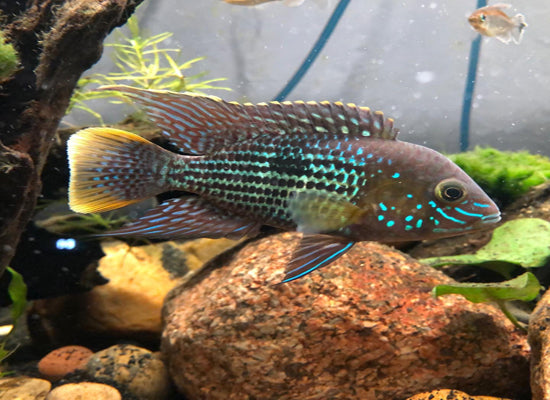
Water & Care Conditions
- pH: 6.0–8.0, ideally 6.5–7.5
- Water hardness: soft to moderately hard, roughly 5–20 dGH
- Temperature: 23–27°C (74–81°F)
- Oxygenation: strong filtration and water movement, non-negotiable for the bioload
Ammonia and nitrite control matter more here than for almost any community fish — a dulling of the mango-orange tone is a useful visible early cue that water quality has slipped, worth checking before other symptoms appear.
Canister or sump filtration rated well above the tank's nominal volume is the norm for this species, not an overkill choice, and weekly water changes of 25–30% are typical given how much a fish this size eats and excretes. "Hole in the head" disease, linked to poor diet and water quality, and ich are the two most common health issues seen in oscars generally — both are largely preventable with a varied diet (quality cichlid pellets plus occasional prawn or earthworm) and consistent water-quality maintenance rather than any special treatment specific to this colour form. Avoid feeder fish as a routine food source; they carry a real disease risk that isn't worth the minor novelty. A well-kept oscar is genuinely long-lived, commonly reaching 10–15 years, so the tank and filtration setup you commit to is a decade-plus arrangement, not a short-term one. Watch for clamped fins, unusual reclusiveness, or loss of appetite as general early warning signs — with a fish this intelligent and normally food-driven, a sudden disinterest in feeding is usually one of the first and most reliable indicators that something in the water or environment has changed. Ich is also worth knowing to recognise on sight — small white spots across the body and fins — since it's common enough in the trade to encounter at some point over a long fishkeeping career and responds well to prompt treatment.