About This Product
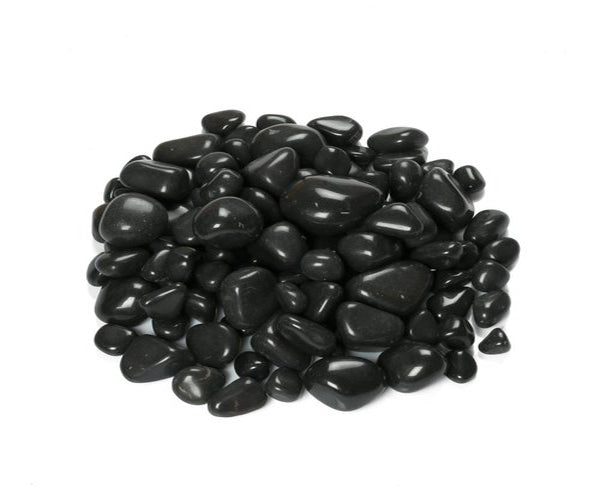
Black polished pebbles are small, smooth, rounded decorative stones used as substrate or accent decor in freshwater aquariums. The polished finish comes from tumbling the stones, which rounds off any sharp edges and gives them a glossy, uniform look -- popular for creating a clean, high-contrast dark substrate that makes brightly coloured fish and plants stand out visually.
Unlike active substrates (like nutrient-rich planted soil), polished pebbles are inert -- they don't buffer pH, release nutrients, or otherwise chemically interact with the water in normal use. That makes them a predictable, low-maintenance choice: what goes in the tank stays chemically stable, which suits keepers who want a purely aesthetic substrate or accent layer without it affecting water parameters.
They're commonly used as a full substrate layer in a smaller tank or bowl, as a contrasting accent scattered among a lighter substrate, or as a base layer under and around driftwood/rockwork in an aquascape.
Dark substrate in general is also a popular choice specifically because it tends to make fish colour up more confidently -- many fish species show bolder, more saturated colouration against a dark background than a pale one, a well-documented behavioural response to perceived visibility/safety.
"Black" polished pebbles aren't perfectly uniform in colour the way a dyed or synthetic product would be -- they're natural stone, typically basalt or a similar dark igneous rock, so individual pieces vary slightly from deep charcoal to near-black with the odd fleck of grey or brown mineral content. This natural variation is part of the appeal for aquascapers who want a substrate that reads as a single dark colour from a normal viewing distance while still having the subtle texture of real stone up close, rather than the flat, uniform look of dyed gravel.
They're typically sold sorted into a fairly narrow size range (commonly somewhere in the 1-2cm diameter band for "pebble" grade, as distinct from finer "sand" grades or larger "stone"/"rock" grades), which keeps the finished substrate bed looking even and prevents the mix of tiny and large pieces that can make a substrate look untidy or trap excess debris in the gaps.
Requirements
No power or special setup is needed -- these are a purely passive decor item. Before adding them to a tank, rinse thoroughly in plain water (no soap) until the rinse water runs clear, since polished stones often carry dust and fine debris from manufacturing/transport that would otherwise cloud the water.
Consider the size and weight of fish that will be kept over them -- very fine gravel-digging or burrowing fish/invertebrates may prefer a finer substrate, while these pebbles suit open swimmers and most community fish well. If used as a full substrate bed for a planted tank, keep in mind that (being inert) they offer no nutrient value to root-feeding plants, so root tabs or a nutrient-rich layer underneath would be needed for anything beyond very undemanding plants.
A depth of roughly 3-5cm is a reasonable layer for a full substrate use; less is needed if just accenting around hardscape or other substrate.
Being inert, these pebbles work equally well over a bare-bottom setup with hardscape resting on top, or as the sole substrate in a simple fish-focused tank -- they don't require any capping layer or special preparation beyond the initial rinse.
To work out roughly how much you need, a common rule of thumb for gravel-sized substrate is about 1-1.5kg per litre of tank volume for a standard ~5cm depth, though the exact figure varies with the footprint of the tank (a long, shallow tank needs more per litre of water than a tall, narrow one for the same substrate depth). It's generally better to slightly over-buy than run short mid-setup, since colour/batch variation between bags can be more noticeable if you have to top up later with a different batch.
If layering over an active planted substrate, these pebbles work well as a decorative cap that hides the nutrient substrate underneath while still letting roots reach down through the gaps -- just avoid packing them down so tightly that they compact the layer beneath and restrict root growth or trap anaerobic pockets.
Compatibility

Care & Maintenance
Being inert and passive, these pebbles need very little ongoing care.
- Before use: rinse thoroughly until water runs clear; a light scrub if visibly dusty
- Maintenance: gravel-vacuum around/through them during routine water changes to clear trapped waste and uneaten food, same as any substrate
- Chemical stability: inert and non-reactive -- won't alter pH or hardness under normal aquarium conditions
- Algae: like any substrate, can grow a film of algae over time in a well-lit tank; this is normal and can be reduced with algae-eating tankmates or manual cleaning
- Longevity: polished stone doesn't degrade or dissolve, so it's effectively a one-time, permanent addition to the tank
- Fish safety: smooth, rounded edges from the polishing process make this a safe substrate for barbel-sensitive bottom-dwellers like corydoras and loaches
- Reuse: can be removed, rinsed, and reused in a different tank setup if the layout ever changes
- CO2/planted setups: being chemically inert, it has no interaction with injected CO2 or liquid ferts -- safe to use in a pressurised planted tank without affecting dosing
- Colour stability: as natural polished stone rather than a dyed product, the colour won't fade, flake, or leach dye into the water over time the way some cheaply coloured gravels can
- Deep-cleaning: if the tank ever needs a full strip-down, pebbles can be boiled briefly or soaked in a dilute bleach solution (rinsed thoroughly and dechlorinated afterward) to fully sanitise them before reuse
- Weight/settling: as with any heavy substrate, avoid pouring straight from the bag onto bare glass -- add a little water first, or pour gently onto a plate/dish placed on the base, to prevent scratching the tank floor
- Compatibility with equipment: won't interfere with undergravel filtration, root-tab fertiliser insertion, or any standard filter/heater placement -- it behaves the same as any inert gravel substrate around aquarium hardware