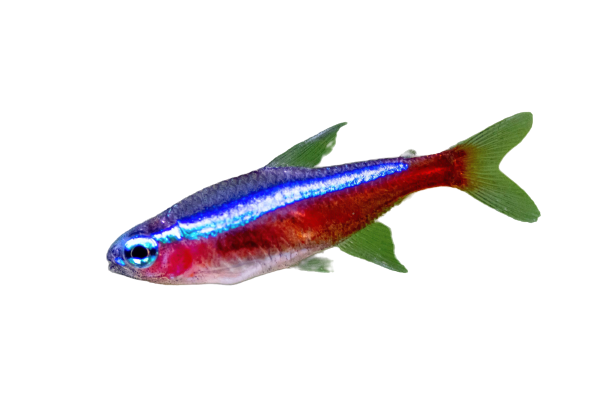
The cardinal tetra is a freshwater fish of the family Characidae of order Characiformes. It is native to the upper Orinoco and Negro Rivers in South America.
= > EASY TO MAINTAIN
=> COMPATIBLE WITH ALL TETRAS,GUPPIES, SHRIMPS
=> BEST FOR PLANTED TANK
About & Origin
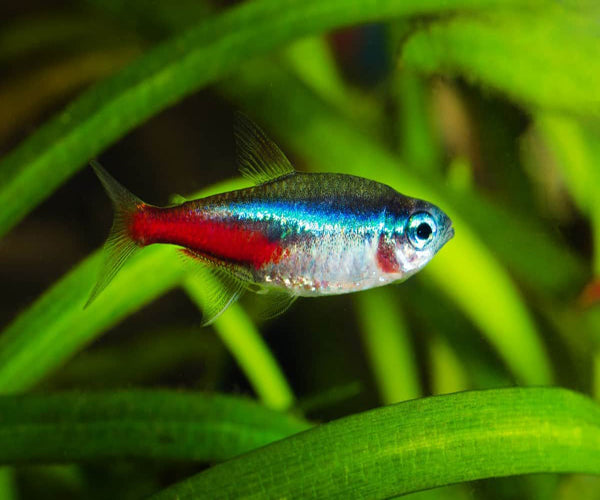
The cardinal tetra (Paracheirodon axelrodi) is a small, vividly-coloured tetra that comes from the black-water and clear-water tributaries of the upper Rio Negro and Orinoco basins in Brazil, Colombia, and Venezuela, where it shoals in enormous numbers over leaf litter and submerged wood in tannin-stained, very soft, acidic water.
It's easily confused with the neon tetra, but the cardinal's iridescent blue stripe and red band both run the full length of the body, rather than the neon's red only covering the rear half -- a small but reliable way to tell them apart.
In the wild it's one of the most heavily-collected ornamental fish in the world, and while much of the trade is still wild-caught from sustainable Amazon fisheries, captive-bred stock is increasingly available and tends to be a little more adaptable to varied tap water.
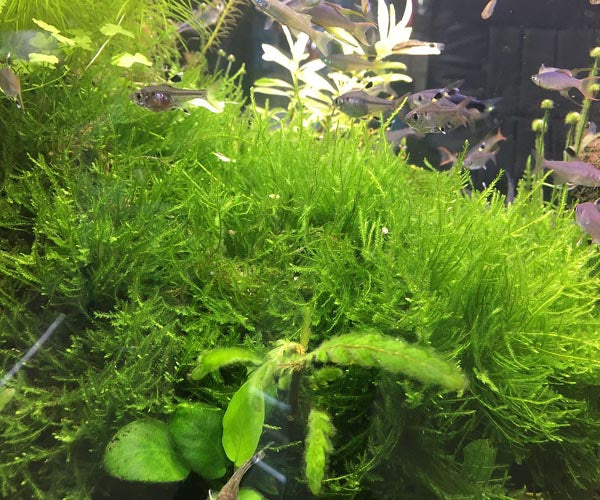
Its intense, almost neon-lit red-and-blue coloring comes from iridophore cells that reflect light structurally rather than from pigment alone, which is why a shoal can look dramatically different depending on the angle and intensity of the light hitting it -- flat, washed out under harsh overhead lighting, but brilliantly lit up when viewed against dark substrate with softer, more natural-feeling light. This is also why cardinal tetras are considered one of the best "showcase" fish for a well-lit planted tank: the colour genuinely rewards a thoughtfully lit aquascape rather than a bare, brightly lit box.
Cardinals are relatively short-lived compared to some tetras, typically 3-5 years in captivity, though well-kept fish in stable, appropriate water can live somewhat longer.
The species was formally described only in the 1950s, relatively late for such a now-iconic aquarium fish, and its discovery and subsequent popularity played a real role in expanding the ornamental fish export trade out of the Rio Negro region -- a trade that today, when managed sustainably, provides meaningful income to local communities and is often credited with helping protect large stretches of Amazon blackwater habitat from more destructive land uses.
Requirements
Cardinals are a true shoaling fish and should be kept in groups of at least 8-10 -- a tight, confident shoal displays its colour far better than a handful of nervous individual fish, and the fish itself is calmer and healthier in numbers.
A tank of 60cm (24in) or more with dim lighting, floating plants, and driftwood to diffuse the light suits them well and reduces the washed-out look cardinals can get under bright, bare setups.
It's a small, peaceful micro-predator in the wild, picking off tiny insects and invertebrates -- in the tank it takes micro-pellets, flake crumbled small, and live or frozen baby brine shrimp and daphnia enthusiastically.
Cardinals can be more sensitive during the initial acclimation period than some other tetras, particularly if moved between very different water chemistries -- a slow, drip-style acclimation over an hour or more, rather than a quick dump-and-go introduction, meaningfully reduces stress and early losses, especially for wild-caught stock.
Adding a handful of dried leaf litter (catappa/Indian almond leaves are the common choice) or driftwood to the tank both looks the part and gently tints the water with tannins, nudging conditions closer to their soft, acidic natural habitat while also releasing mild antimicrobial compounds many keepers credit with helping newly imported fish settle in.
A tightly-stocked, well-established shoal also tends to be noticeably bolder and more colourful than a sparse or newly assembled one -- if budget allows, buying the full target group size (8-10+) up front rather than adding a few fish at a time gives a faster, more confident, better-coloured result.
Beyond stocking density, general maintenance stays simple: a well-cycled filter, regular but not oversized water changes, and a varied diet of small-particle foods are all this species really needs beyond the water-chemistry and lighting considerations already covered above.
Compatibility
Water & Care Conditions
True to its blackwater Amazon origins, the cardinal tetra is happiest in soft, acidic, tannin-tinted water, though captive-bred stock is more forgiving than wild fish:
- pH: 5.0–7.0 (does best on the softer, more acidic end, but adapts to moderate hardness)
- Water hardness: soft, 1–10 dGH
- Temperature: 23–27°C (73–81°F)
- Oxygenation: gentle flow; avoid strong current, which doesn't match its calm blackwater habitat
- Lighting: dim to moderate, ideally filtered through floating plants or diffused rather than harsh and direct, both for comfort and to show off its colour properly
- Tannins: a light tannin tint from driftwood or leaf litter is welcomed, not a problem to filter out -- it mirrors the blackwater habitat this species evolved in
- Water changes: regular, moderate partial water changes (avoid large, sudden swings in pH or hardness, which this species tolerates poorly compared to harder-water fish)
- Stocking: best added to an already-cycled, stable tank rather than one still going through its initial nitrogen cycle, since cardinals are noticeably less forgiving of ammonia/nitrite spikes than hardier community fish
- Acclimation: use a slow, drip-style acclimation over an hour or more rather than a quick introduction, especially when moving fish between differing water chemistries
- Health signs: a healthy, settled shoal swims actively in open water with strong, saturated colour -- pale, washed-out colouring or clamped fins are early signs of stress or poor water quality worth investigating promptly
- Feeding: feed small amounts once or twice daily rather than one large feeding -- their tiny mouths mean uneaten food can quickly foul water if portions are sized for a larger fish
- Compatibility with new tanks: avoid adding cardinals to a freshly set-up aquarium under a few weeks old -- let biological filtration establish fully first, since this species is among the least tolerant of early-cycle ammonia and nitrite spikes