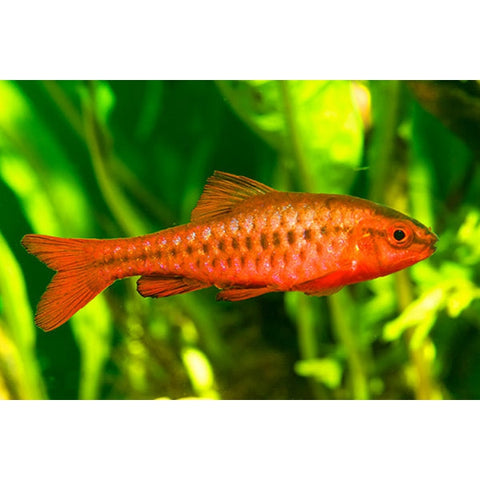
CHERRY BARB

Cherry Barb Fish

  • Sale
  • Rs. 45.00
  • Regular price Rs. 60.00
Tax included. Shipping calculated at checkout.


The cherry barb is a tropical freshwater fish belonging to the family Cyprinidae. It is native to Sri Lanka, and introduced populations have become established in Mexico and Colombia. The cherry barb was named Puntius titteya by Paules Edward Pieris Deraniyagala in 1929

About & Origin

The Cherry Barb (Puntius titteya) is a small, peaceful barb native to the slow streams and shaded forest pools of Sri Lanka, where it's now considered vulnerable in the wild due to habitat loss — most fish in the trade today are farm-bred, which also makes them an easy, sustainable choice for a home aquarium. In these dim, tannin-stained forest waters they forage among leaf litter and marginal vegetation for small insects, worms, and algae, an omnivorous diet reflected in how easily they accept prepared foods in captivity.

It's one of the calmest members of the barb family. Males develop a deep, glowing cherry-red body colour that intensifies with good diet, mood, and breeding condition, while females stay a more subdued brownish-gold with a dark lateral stripe. A small, slender fish that rarely troubles anything else in the tank, reaching only around 5cm (2in) at full size.

Unlike its more boisterous tiger barb cousins, the Cherry Barb is a genuinely peaceful shoaler, which is why it's a long-time favourite for planted community tanks. It's an egg-scattering species: given warm, soft, slightly acidic water and fine-leaved plants or a spawning mop, a conditioned pair will spawn without much encouragement, though as with most barbs the parents show no brood care and will eat the eggs if given the chance.

Cherry Barbs typically live 4 to 6 years with good care, and have been a staple of the hobby since being formally described in the late 1920s, prized for combining vivid colour with a genuinely easy-going temperament rarely found together in the same fish.

In the wild, the species is now classified as vulnerable by the IUCN, largely due to deforestation and agricultural runoff degrading the shaded lowland streams it depends on around Sri Lanka's wet zone. That makes captive-bred stock — which is the overwhelming majority of what's sold in the hobby today — a genuinely more sustainable choice than wild-caught fish, and also explains why farm-raised Cherry Barbs tend to be so much more colour-consistent and disease-resistant than their wild ancestors: decades of selective line-breeding for vivid red males have been layered on top of a species that was already easy to spawn in captivity.

Requirements

Cherry Barbs are easy-going and forgiving, making them a solid choice even for less experienced keepers.

Group size: keep at least 6, ideally more — they shoal loosely rather than tightly, but feel more secure and show better colour in a proper group. A higher ratio of females to males (roughly 2:1) tends to spread male attention out and results in calmer, more consistent colouring across the group.

Tank size: a 10–15 gallon (40–60L) tank is enough for a small group, since Cherry Barbs stay small (around 5cm/2in) and are unhurried swimmers compared to other barbs — they spend much of their time investigating plant cover rather than patrolling open water.

Planting: they appreciate a well-planted tank with some open swimming space — dense planting also gives shier females and fry places to retreat to, and mimics the shaded, vegetation-choked streams they come from. Floating plants that soften overhead light are particularly appreciated.

Diet: omnivorous; a quality flake or micro-pellet staple, supplemented with occasional live or frozen foods (daphnia, brine shrimp, bloodworm) for the best colour and conditioning ahead of breeding.

Tankmates: their calm temperament makes them one of the more flexible barbs for a mixed community — they do well alongside other small, peaceful fish rather than needing a species-only setup.

Filtration and flow: a standard sponge or hang-on-back filter is plenty; unlike open-water barbs they don't seek out strong current, and gentle-to-moderate flow that doesn't blast them out of the planted areas they prefer is ideal. As with most soft-water fish, avoid running crushed coral or other hardness-raising media in the filter, since it will push water chemistry away from the slightly soft, acidic range they do best in.

Acclimation: new arrivals should be drip-acclimated slowly over 20–30 minutes rather than dropped straight in, since Cherry Barbs can be sensitive to sudden shifts in pH or temperature immediately after transport — a stressed fish will often show duller colour and hide for the first day or two before settling in.

Compatibility

One of the most genuinely peaceful barbs — pairs well with other calm community fish and dense planting:

Water & Care Conditions

Cherry Barbs are hardy and adapt to a range of conditions, but colour up best and breed most readily within these ranges:

  • pH: 6.0–7.5, leaning slightly acidic to neutral
  • Water hardness: soft water, roughly 5–12 dGH
  • Temperature: 22–26°C (72–79°F)
  • Oxygenation: comfortable in typical community-tank flow; doesn't need strong current
  • Water changes: a weekly 20–25% partial change keeps water quality stable; as with most soft-water species, letting nitrate creep up will dull male colouration over time

They tolerate slightly softer, more acidic water better than most barbs, reflecting their native shaded forest streams, but otherwise fit easily into a standard planted community setup. Males held in poor conditions or under stress noticeably lose their red intensity, fading toward the duller female colouring — so vivid colour is a genuinely useful, easy-to-read indicator that a Cherry Barb is healthy and comfortable in its environment.

They're generally disease-resistant when kept in stable conditions, though like most small tropical fish they're susceptible to ich if exposed to sudden temperature swings or a poorly cycled tank. New arrivals should be acclimated slowly and, where possible, given a few weeks of quarantine before joining an established community.

If breeding is the goal, a dedicated spawning tank set slightly warmer (around 26–27°C) and softer/more acidic than the main display, with fine-leaved plants or a spawning mop, tends to produce the most reliable results — adults should be removed after spawning since, like most barbs, Cherry Barbs will readily eat their own eggs and newly hatched fry if left in the tank. Eggs typically hatch within 24–36 hours, with fry free-swimming a few days later and ready for infusoria or commercial fry food.

A well-established tank with mature filtration and steady dosing of any supplements handles this species best; avoid sudden large water changes, and dose any medications at half the labelled strength as a precaution, since barbs as a family tend to be more sensitive to some treatments than larger, hardier community fish.