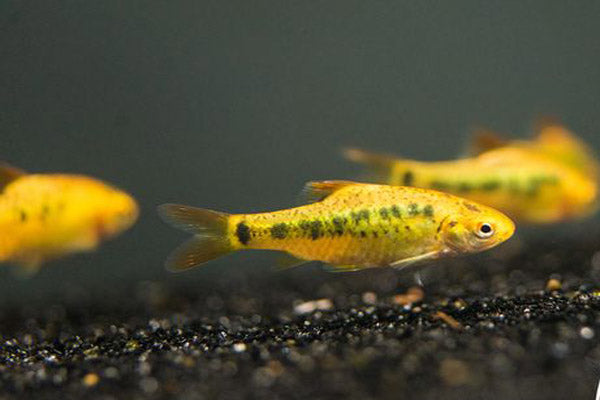
About & Origin
The Golden Barb (Barbodes semifasciolatus), sometimes called the Chinese Barb, comes from the slow streams, ditches, and rice-paddy-adjacent waters of southeastern China, Vietnam, and Taiwan. The commonly traded "golden" form is a selectively bred colour variety of the wild olive-green barb, prized for its warm gold-bronze sheen with faint dark blotches along the flank, developed by hobbyist breeders decades ago and now more widely available than the plainer wild-type colouring.
It's a small, hardy, unfussy fish that's been a mainstay of the hobby for decades precisely because it tolerates a wide range of conditions and rarely causes trouble — a good all-rounder for a peaceful community tank, and one of the more forgiving barbs for a first-time keeper still learning to read water quality and stocking levels.
Golden Barbs are active mid-water swimmers that shoal loosely, spending much of their time cruising open water and picking at algae and biofilm along the way. In the wild their omnivorous diet also includes small insects, worms, and plant matter picked from the margins of slow, weedy waterways — the same varied foraging instinct that makes them easy to feed a broad diet in the aquarium.
Like most small barbs they're egg-scatterers, spawning over fine leaved plants with no parental care of the eggs or fry afterward. With decent care they typically live 4 to 5 years, and their combination of easy care, mild temperament, and warm colouring has kept them a steady, if understated, presence in the hobby since long before more flashily marketed barbs became popular.
The species name still causes some confusion in the hobby: older literature and some retailers list it as Puntius semifasciolatus or Capoeta semifasciolatus, reflecting a genus that's been reshuffled by taxonomists more than once. Whatever the label, the fish itself hasn't changed — it remains one of the most consistently available, budget-friendly barbs in the trade, in part because it breeds so readily and reliably in captivity that most stock sold today is several generations removed from any wild-caught ancestor.
Requirements
Golden Barbs ask very little and are a good choice for a first community tank.
Group size: keep at least 5–6; they're a shoaling species and settle better, with less fin-nipping tendency, in a proper group. As with most barbs, an undersized group tends to redirect social behaviour toward tankmates rather than each other.
Tank size: a 15–20 gallon (55–75L) tank comfortably suits a small group, since Golden Barbs stay compact (around 6cm/2.5in) and are unhurried, easy-going swimmers compared to more boisterous barb species.
Temperature tolerance: notably cooler-tolerant than many tropical barbs — they don't strictly require a heater in a warm room, though stable mid-tropical temperatures are still fine. This flexibility makes them a genuinely good match for both heated tropical setups and cooler, unheated community tanks.
Diet: omnivorous and easy — flake or small pellet as a staple, with occasional live or frozen food and some grazing on algae/biofilm growing naturally in the tank, which also helps keep glass and decor cleaner.
Decor and tankmates: a mix of open swimming space and some planting suits their loose shoaling style well, and their calm nature makes them a safe, flexible addition to most peaceful community setups without the fin-nipping reputation some other barbs carry.
Filtration: standard community filtration is fine — they're not fussy about flow rate and do well with either a sponge filter or a hang-on-back unit, provided the tank cycles fully before fish are added.
Unheated setups: because of their cooler-tolerant range, Golden Barbs are one of the barbs worth considering for an unheated "coldwater community" tank alongside similarly hardy species — just avoid pairing them with true tropical fish that need consistently warmer water than a Golden Barb strictly requires.
Compatibility

Water & Care Conditions
One of the more forgiving barbs on water chemistry, which is part of why it's stayed popular for so long:
- pH: 6.5–7.5
- Water hardness: soft to moderately hard, roughly 5–15 dGH
- Temperature: 18–24°C (64–75°F) — comfortable even without a heater in many climates, though stable tropical temperatures are fine too
- Oxygenation: not demanding; standard community-tank filtration and flow is sufficient
- Water changes: a weekly 20% partial change is enough to keep this hardy species in good shape long-term
Consistency matters more than hitting an exact number — Golden Barbs handle a wide window well as long as the water stays clean and stable. Rapid swings, rather than the absolute parameter values, are what tend to cause stress or illness in an otherwise resilient species like this one.
They're generally disease-resistant and rarely the first fish to show problems in a struggling tank, which makes them a useful "canary" species in a mixed community — if a Golden Barb starts looking off-colour or listless, it's often worth checking water quality before assuming an individual health issue. As with most barbs, sudden cold-water shock during a large, poorly matched water change is a more common cause of stress than any single water-chemistry parameter being slightly outside the ideal range.
If breeding, a slightly warmer, softer spawning tank with fine plants encourages egg-scattering, and adults should be removed promptly afterward since they'll eat their own eggs given the chance. Fry are tiny and need infusoria or liquid fry food for the first week or two before they're large enough for powdered flake.
They're one of the hardier barbs when it comes to disease resistance, and rarely present health problems in a well-maintained tank; the main risk, as with most small shoaling fish, is ich introduced by an unquarantined new arrival, so acclimating and ideally quarantining newcomers before adding them to an established Golden Barb group is worthwhile.