About & Origin
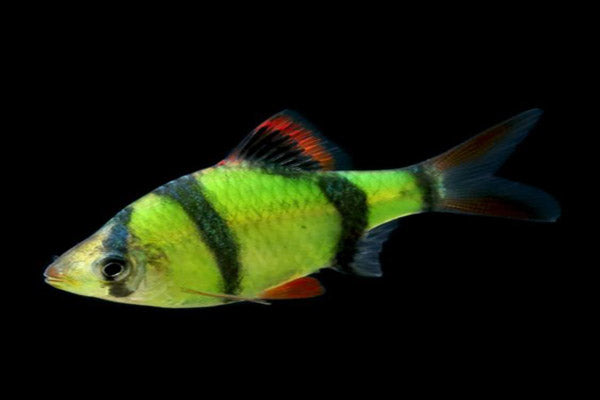
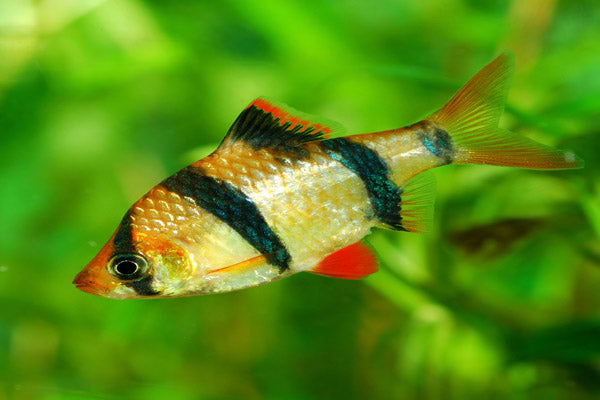
The Green Tiger Barb is a colour-morph of the Tiger Barb (Puntigrus tetrazona), native to the slow, vegetation-lined streams of Sumatra, Borneo, and other parts of Indonesia and Malaysia. Selective breeding has replaced the wild-type's orange-gold base with a moss-green body, while keeping the same bold black vertical banding across the flanks — a colour variant produced through generations of selective breeding by aquarium-trade breeders rather than something found in wild populations.
Underneath the colour, it's the same fast, gregarious, shoaling fish as the standard Tiger Barb — constantly active, always on the move, and happiest in numbers. In the wild, this species forages omnivorously through leaf litter and plant growth for insects, worms, and plant matter, which is why it accepts such a wide range of prepared and live foods so readily in captivity.
It carries the same well-known fin-nipping reputation as its relatives, which in practice is almost entirely a matter of group size rather than an unavoidable trait of the fish — a properly sized shoal channels that pecking-order energy into brief chasing and fin-flaring between shoal members instead of aimed at other tank residents.
Like the standard form, Green Tiger Barbs are egg-scattering spawners with no parental care, typically live 5 to 7 years with good care, and combine the same low-maintenance hardiness that's kept the base species popular in the hobby for well over a century.
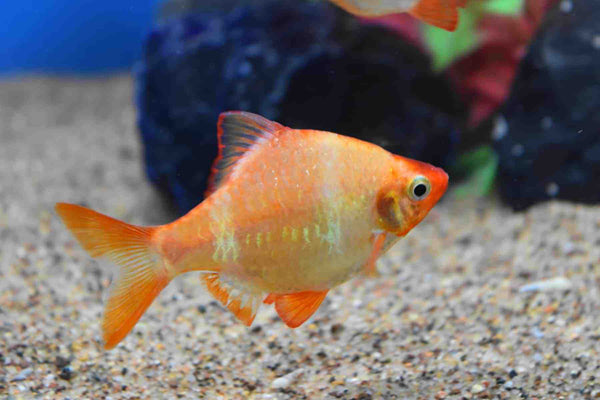
Because the green colouring is a selectively bred trait rather than a fixed genetic line, colour intensity can vary a little between individuals and even fade or shift slightly over a fish's lifetime depending on diet, lighting, and general condition — a well-fed, low-stress fish in a planted tank with good lighting will generally show the richest, most even green tone. Some keepers mix green, standard, and albino Tiger Barb forms in the same shoal, which works fine since they're all the same species and school together readily regardless of colour.
Requirements
Exactly the same needs as a standard Tiger Barb — colour aside, this is the same species with the same behaviour.
Group size: 6 or more. Kept in smaller numbers, their hierarchy behaviour turns into fin-nipping other tankmates; in a proper shoal it stays directed at each other, and larger groups of 8-10 tend to settle down even further.
Tank size: a 20-gallon (75L) long tank is a reasonable minimum for a group of 6, with more room appreciated for these active swimmers that use horizontal space more than vertical height.
Diet: omnivorous — quality flake or small pellet staple, with occasional frozen or live foods (bloodworm, brine shrimp, daphnia) for conditioning and colour, fed a couple of times a day in amounts cleared within a minute or two.
Filtration & flow: benefits from moderate current and well-oxygenated, well-filtered water, matching their native flowing-stream habitat.
Tankmate selection: pairs best with fast, robust community fish rather than slow-moving or long-finned species, which tend to be the ones targeted if the shoal is under-sized or under-stimulated.
Enrichment: driftwood, rockwork, or planting broken up with open swimming lanes gives an active shoal something to patrol and interact with, which in practice reduces how much of their energy ends up directed at tankmates.
Acclimation: a slow 20-30 minute drip acclimation for new arrivals reduces the initial stress that can trigger ich in a freshly introduced group, especially important since barbs are prone to spreading it quickly once one shoal member is affected.
Feeding for colour: a diet rich in natural or added carotenoids (spirulina-based flake, some frozen foods) tends to support brighter, more saturated green tones over time, similar to how colour-enhancing foods work for other selectively bred fish.
Compatibility
Water & Care Conditions
Hardy and adaptable, like all Tiger Barb colour forms, doing best within these ranges:
- pH: 6.0–7.5
- Water hardness: soft to moderately hard, roughly 5–15 dGH
- Temperature: 20–26°C (68–79°F)
- Oxygenation: appreciates good water movement and well-oxygenated water
- Water changes: weekly 20–25% partial changes suit this active, waste-producing shoaling fish
Tolerates normal community-tank swings well as long as ammonia and nitrite stay at zero — clean, stable water matters more than hitting an exact number. As with all Tiger Barb forms, sudden temperature drops or a newly set up, immature filter are the most common triggers for ich outbreaks, which can move quickly through a shoal once it takes hold.
A healthy, well-conditioned Green Tiger Barb should be constantly active and holding its full colour — clamped fins, unusual hiding, or a fish that's paled toward the wild orange-gold base colour are all worth investigating as early stress or illness signs. If breeding, a warmer, softer, densely planted spawning tank with adults removed after spawning gives the most reliable results.
Dose any medication to the tank's true water volume rather than its nominal size, since substrate, decor, and equipment all reduce actual water content — this hardy species tolerates standard treatments well, but overdosing from an inflated volume estimate is a more common real-world mistake than underdosing.
Quarantining new stock for two to three weeks before adding it to an established shoal is good practice with any barb, giving time for both ich and any less obvious parasites or bacterial issues to show themselves in isolation rather than spreading through the whole display tank.
Otherwise this is a tough, forgiving fish once established, and a stable, well-maintained tank is really all it needs to reach its full 5-to-7-year lifespan without health issues.