About & Origin
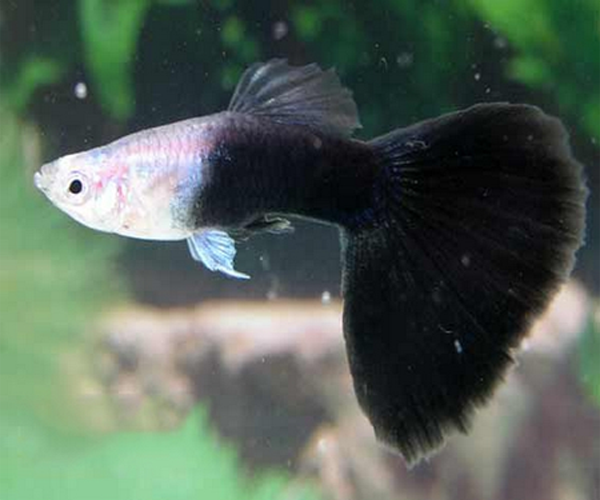
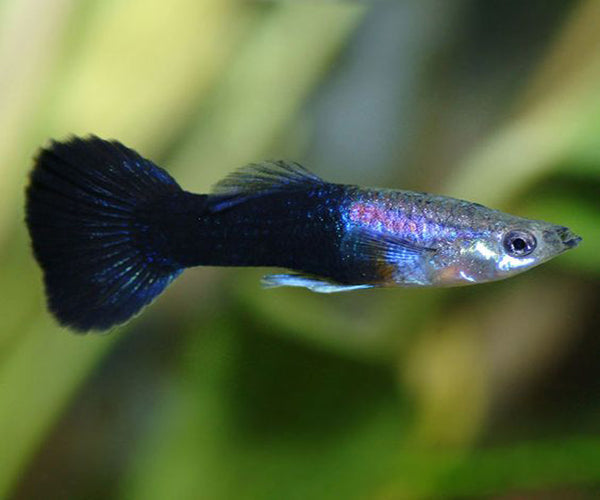
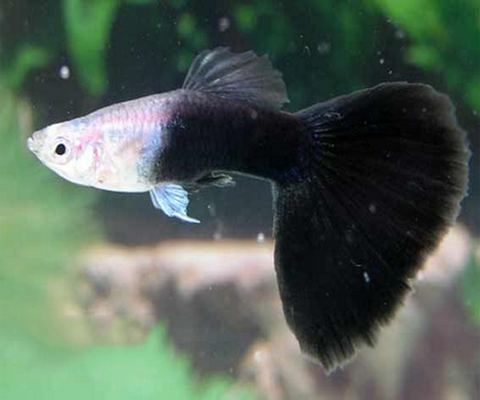
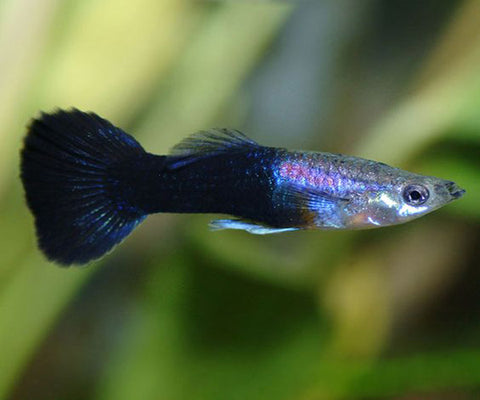
The Half Black Guppy is one of the classic fancy guppy strains (Poecilia reticulata), named for the solid black coloring that covers the rear half of the body while the front half and fins carry the strain's base color. Wild guppies originate from streams, ponds, and coastal waters across Venezuela, Trinidad, Guyana, and northern Brazil, where they're known as "million fish" for how readily they breed and adapt.
In the wild, guppies live in shallow, warm, often nutrient-rich water and are famous among biologists for how fast they adapt to local conditions — including to predators, which has made them one of the most studied fish in evolutionary biology. In the aquarium hobby, that same adaptability is exactly what makes guppies such a reliable beginner fish.
The "half black" pattern is one of the oldest and most established strain categories in competitive guppy breeding, prized for the sharp, clean division line between the pigmented rear half and the plain front half — a trait breeders select for generation after generation, since a blurred or uneven line is considered a fault in show-quality lines. It's typically paired with other color genes in the tail and dorsal fin (as with this strain's base color), so "half black" describes the body pattern layer while the fin coloring is bred in separately on top of it. Guppy show classes worldwide (IFGA and similar) still judge half-black varieties as a distinct category, which is part of why the pattern has stayed so consistent and recognizable across generations of breeding.
The Half Black Guppy strain sold here is bred and raised for the aquarium trade specifically for its coloring and finnage; its care, temperament, and water needs are identical to any other guppy variety.
fishykart.com ships healthy, actively-colored stock, not fish pulled straight from a wholesale feeder tank.
Requirements
Standard guppy husbandry applies (10 gallon/38 litre minimum for a group of 6+, roughly 2 litres per adult, female-heavy sex ratio, omnivorous flake/micro-pellet diet with occasional live/frozen foods, floating or fine-leaved plants for fry cover, a tight lid since they jump, fry every 4-6 weeks once mature).
This strain specifically: Half Black is one of the oldest, most established fancy guppy strains, selectively line-bred for a sharp, clean boundary between the solid black rear half and the coloured front half rather than a blended gradient — breeders judge quality partly on how crisp that dividing line is. Because it's a well-fixed, long-standing strain rather than a newer novelty cross, it tends to breed relatively true to type from a single-strain group, with less colour drift in the fry than some newer hybrid strains show.
Fin variants: Half Black guppies are bred across several tail shapes — veiltail, delta, and lyretail versions all exist under the same "half black" body-colour banner, so two fish sold under this name can still look quite different in silhouette even with an identical colour pattern. If you're planning to breed rather than just keep a display group, buying from a single fin-type line will give more predictable-looking fry than mixing tail shapes.
Sourcing tip: look for a crisp, high-contrast line between the black rear and the coloured front on the fish you select — a blurry or gradient transition usually indicates crossbreeding with a non-Half-Black strain somewhere in that fish's ancestry, and won't breed as true if colour consistency matters to you.
Group composition: keep more females than males (roughly 2–3 females per male) to spread out mating attempts and reduce stress on any one female — male guppies court almost constantly, and an all-male or male-heavy group tends to squabble over the available females instead.
Compatibility

Water & Care Conditions
- pH: 6.8–7.8
- Salinity / hardness: freshwater, moderately hard (10–20 dGH)
- Temperature: 24–28°C (75–82°F)
- Oxygenation: moderate surface movement, avoid stagnant water
Stability matters more than precision. On this strain, watch for the black/colour dividing line blurring or the black looking patchy rather than solid — a sign worth investigating even before other stress symptoms appear.
Weekly 20-25% water changes support colour and finnage and reduce fin rot/ich risk; acclimate new arrivals slowly (20-30 minute drip) rather than a quick release.
Captive-bred and adaptable to ordinary dechlorinated tap water once roughly in range. Typical lifespan in a well-kept tank is 2-3 years.
A dark substrate and background genuinely help this strain's signature feature read clearly — against pale gravel, the boundary between the black rear and coloured front can look softer and less striking than it actually is. Feeding a varied diet including some carotenoid-rich food (brine shrimp, colour-enhancing flake) a few times a week helps keep the front-half coloration vivid without affecting the black portion, which is pigment-based rather than diet-responsive. As with all guppies, avoid sudden hard water changes — this strain, like most fancy guppy lines, has been captive-bred for many generations and can be more sensitive to abrupt parameter swings than its wild ancestors, even though it tolerates a fairly wide steady-state range. Watch young fry closely in a community setup — adult guppies, including their own parents, will happily eat newborn fry, so a densely planted tank or a separate breeding trap is worth considering if you actually want the fry to survive to adulthood. Females are able to store sperm and can produce several broods from a single mating, so even a female bought alone may still give birth weeks after arriving.