About & Origin
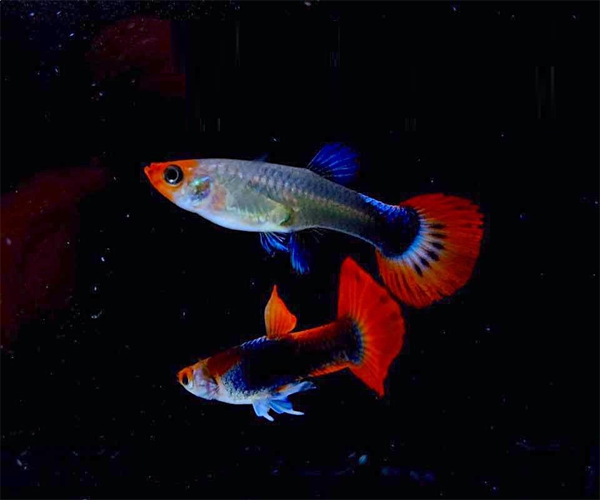
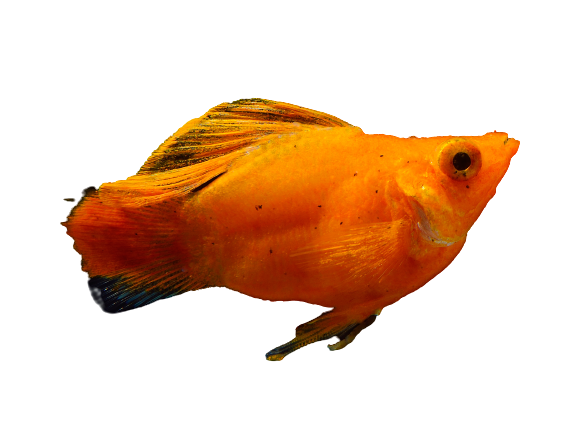
The Koi Guppy is a fancy guppy strain (Poecilia reticulata) bred for a mottled orange, black, and white pattern that echoes koi carp coloring. Wild guppies originate from streams, ponds, and coastal waters across Venezuela, Trinidad, Guyana, and northern Brazil, and this strain is a purely ornamental color selection from that same hardy, adaptable species.
In the wild, guppies live in shallow, warm, often nutrient-rich water and are famous among biologists for how fast they adapt to local conditions — including to predators, which has made them one of the most studied fish in evolutionary biology. In the aquarium hobby, that same adaptability is exactly what makes guppies such a reliable beginner fish.
The koi pattern is a mosaic/tricolor type, combining a variegated patchwork of red-orange, black, and white across the body and fins rather than a single solid tone or a simple two-tone split like a half black strain — each fish's exact patch layout ends up somewhat individual, similar to how no two koi carp look identical, even within the same breeding line. Because the pattern involves several interacting color and pattern genes rather than one simple trait, koi-strain guppy litters tend to show more visible variation between siblings than single-gene strains, and breeders typically cull and select the most evenly patterned individuals to keep breeding forward.
As with real koi carp, the pattern also tends to develop and shift somewhat as the fish matures, so a young koi guppy's markings aren't necessarily its final adult look — expect the patchwork to fill in and sharpen over the first several months rather than staying static from the day it arrives.
The Koi Guppy strain sold here is bred and raised for the aquarium trade specifically for its coloring and finnage; its care, temperament, and water needs are identical to any other guppy variety.
fishykart.com ships healthy, actively-colored stock, not fish pulled straight from a wholesale feeder tank.
Requirements
Standard guppy husbandry applies (10 gallon/38 litre minimum for a group of 6+, roughly 2 litres per adult, female-heavy sex ratio, omnivorous flake/micro-pellet diet with occasional live/frozen foods, floating or fine-leaved plants for fry cover, a tight lid since they jump, fry every 4-6 weeks once mature).
This strain specifically: the mottled orange/black/white "koi" pattern is random per fish rather than a fixed, symmetric design — no two Koi Guppies pattern identically, similar to how real koi carp vary individually. Because the pattern is irregular rather than a clean colour block, it's genetically less predictable to breed true than a solid-colour strain — fry from two Koi Guppies can vary quite a bit in how much orange, black, or white they end up showing.
Sexing note: males typically show a bolder, more concentrated pattern with a larger dorsal and tail fin, while females carry a more muted version of the same colouring on a larger, plainer body — both sexes count as "Koi" for the strain, so don't be surprised if a mixed group looks visually inconsistent at first glance.
Selective breeding: hobbyists chasing a specific koi look (more orange, cleaner white patches, bolder black) generally need to selectively cull and re-pair fry over a few generations, since a single spawning rarely produces uniform offspring given how the pattern is inherited.
General upkeep: a 10-gallon (38-litre) tank comfortably houses a starter group of six or more, working out to roughly 2 litres per adult fish once you account for their small adult size. They're unfussy omnivores — a good-quality flake or micro-pellet as a staple, supplemented with occasional live or frozen food like brine shrimp or daphnia for condition and colour. A secure lid matters more than people expect; guppies are surprisingly capable jumpers, especially when startled or when water quality has quietly slipped.
Compatibility

Water & Care Conditions
- pH: 6.8–7.8
- Salinity / hardness: freshwater, moderately hard (10–20 dGH)
- Temperature: 24–28°C (75–82°F)
- Oxygenation: moderate surface movement, avoid stagnant water
Stable parameters matter more than an exact number. A dark substrate and background help the koi pattern's contrast show clearly — against pale gravel the white sections can wash out under bright lighting.
Weekly 20-25% water changes support colour and finnage and reduce fin rot/ich risk; acclimate new stock slowly (20-30 minute drip) rather than a quick release.
Captive-bred and generally adaptable to ordinary dechlorinated tap water once roughly in range. Well-kept guppies typically live 2-3 years.
Keep more females than males in a group setup — a ratio of roughly 2 to 3 females per male reduces the constant courtship chasing that stresses females in male-heavy groups. Both sexes are prolific breeders once mature: a female can produce a new brood roughly every 4 to 6 weeks and, because she stores sperm internally, may keep giving birth for months even without a male present. If you'd rather not deal with an expanding colony, floating plants that provide fry cover will actually work against you here — a bare, open tank with adult guppies present is the more effective (if less humane-sounding) way to naturally limit surviving fry, since adults readily eat their own newborns. Fin rot and ich are the two most common issues to watch for, both usually tied back to inconsistent water quality or temperature swings rather than the fish being inherently delicate — a stable, cycled tank with regular partial water changes prevents the great majority of guppy health problems seen in the hobby. Given how visually varied this strain already is, a slightly dulled or faded pattern can be harder to spot as an early stress signal than it would be on a solid-colour guppy — watching overall activity level and appetite is often a more reliable day-to-day health check than colour alone.