About & Origin
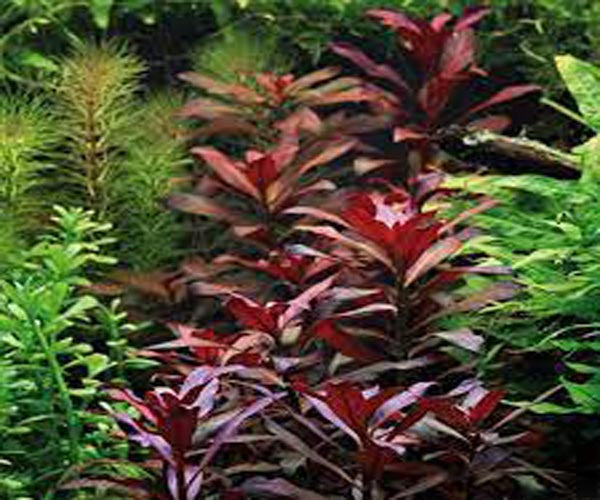
Ludwigia glandulosa is a dark-coloured background aquarium stem plant, native to North America, where it grows in shallow wetlands, ditches, and pond margins across the southeastern and central United States.
It's a taller, upright background stem plant with narrow, lance-shaped leaves that darken toward deep red-brown to almost purple-black under strong light — a distinctively dark, moody colour compared to the brighter reds of many other Ludwigia species. Stems typically reach 15–40cm, forming a dense vertical backdrop once established.
It was previously sold and catalogued under the name Ludwigia perennis in parts of the trade, so it's sometimes still found under that older name — the two names refer to the same plant, and the older label still circulates on labels and forum posts even after the taxonomy settled on glandulosa.
What sets it apart visually from brighter red Ludwigia species is that its dark colouration comes from a genuinely different pigment balance rather than just a deeper shade of the same red — under strong light the leaves can shift toward such a dark brown-purple that they read as almost black from a distance, an effect aquascapers specifically use to create visual depth and contrast against brighter green or red plants nearby, rather than to add colour in the way most red stem plants are used.
In its native wetlands it typically grows as an emersed or partly-emersed marginal plant along pond and ditch edges, and like several of its Ludwigia relatives it can be grown either way in cultivation — fully submerged for the aquarium trade, or emersed in a bog or paludarium setting, though the fully submerged form is what's almost always sold for planted tanks.
Mature stems reaching their full 15–40cm height, combined with the moody dark colouration, make this a plant most often used as a deliberate focal or backdrop element rather than filler — it's chosen specifically for the visual weight and contrast it brings to a layout, not simply to add greenery.
Requirements
This species is slower-growing and a little more demanding than many other Ludwigia.
Light: moderate to high light is needed for good, dark colouration and steady growth; in weak light it grows slowly and stays pale.
CO2: genuinely benefits from supplemental CO2 — it's one of the slower, more particular members of the genus, and CO2 makes a real difference to how well it establishes.
Nutrients: a nutrient-rich substrate and regular fertilising support its slow, steady growth.
Planting and propagation: root as a background stem plant; because it's slow-growing, avoid excessive trimming until it's well established, then propagate by cutting and replanting healthy tops.
Patience during establishment: this is genuinely one of the slower and fussier Ludwigia species to get going — it's common for a newly planted stem to sit largely unchanged for the first couple of weeks while it adjusts and puts out new roots, which can look worrying compared to faster stem plants that visibly grow within days. Resist the urge to move it around chasing better placement during this period; frequent replanting resets the establishment clock and is a common reason keepers give up on this species prematurely.
Algae risk: because it grows slowly, it's more vulnerable than fast growers to being overtaken by algae during the early establishment period, especially in a newly set up tank with unstable nutrient levels — introducing it into an already-mature, well-balanced planted tank rather than a brand-new setup gives it a much better chance of establishing cleanly.
Trimming technique: once established, trim conservatively — cut just above a node and expect a slower regrowth response than with faster stem plants, and don't be discouraged if a trimmed stem takes noticeably longer to bush out compared to species like Rotala or Hygrophila.
Compatibility
Water & Care Conditions
Ludwigia glandulosa is more sensitive to unstable conditions than most of its faster-growing relatives, since a slow grower has less capacity to simply outgrow a rough patch of poor water quality. It does best within these ranges:
- pH: 6.0–7.5
- Hardness: soft to moderate, roughly 2–12 dGH
- Temperature: 22–28°C (72–82°F)
- Light: moderate to high, ideally with CO2 supplementation for good colour and steady growth
- CO2: genuinely benefits from consistent, steady CO2 injection rather than an on-and-off supply — fluctuating CO2 levels tend to stall its already-slow growth more noticeably than in hardier species
- Nutrients: steady, complete fertilisation (nitrogen, phosphorus, potassium, and trace elements including iron) supports the dark colouration; nutrient deficiency tends to show as pale, washed-out leaves rather than the intended deep brown-purple
Given its slower growth, patience matters more than adjusting parameters — it needs time to establish even under good conditions, and a keeper who expects the fast visible progress of a Rotala or Hygrophila will likely be disappointed by how gradually this species fills in. Once established in a stable, mature planted tank, however, it holds its dark colour reliably and doesn't require constant fussing the way its slow initial establishment period might suggest.
Oxygenation: not a particularly demanding plant on this front — normal community-tank surface agitation and filtration provide enough gas exchange, and it doesn't need special aeration beyond what most planted tanks already run for their fish.
A useful way to think about this species: it rewards a stable, already-mature tank far more than it rewards chasing "perfect" numbers on a test kit. Keepers who already run a settled planted setup with consistent dosing and lighting tend to find it far easier to keep than the raw parameter list alone would suggest, while the same plant struggles in an otherwise well-run but newly-cycled tank simply because it hasn't had time to settle.