About & Origin
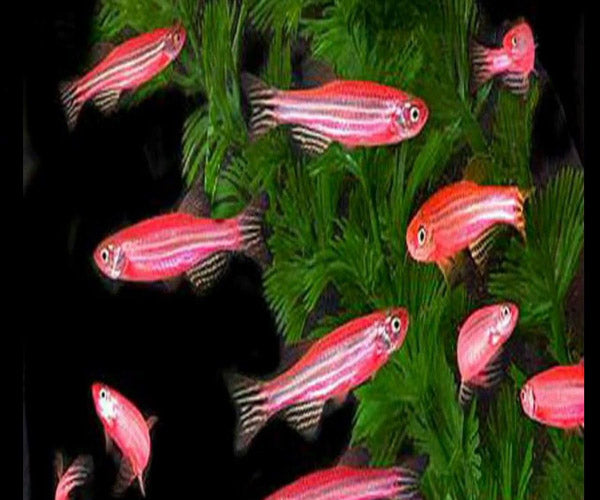
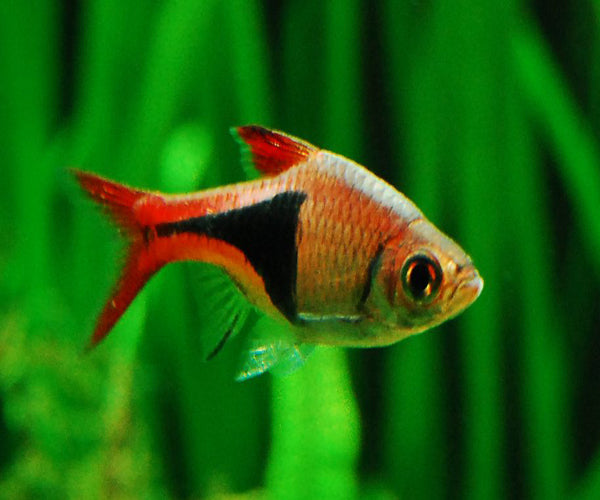
This pink/red-coloured fish is a genetically modified strain of the Zebra Danio (Danio rerio), a small, hardy shoaling fish native to slow-moving streams, rice paddies, and floodplains across the Indian subcontinent. Unlike dyed fish, GloFish-type colour strains carry a fluorescent protein gene expressed throughout the fish's own tissue and passed on genetically to offspring — the colour is a permanent, heritable trait, not a coating or injection.
The underlying species, the common zebra danio, is one of the most widely kept, hardiest small fish in the hobby (and one of the most-used research fish in the world), known for constant, energetic swimming and genuine ease of care regardless of colour strain.
Wild-type zebra danios show the classic horizontal blue-and-gold stripes running the body length; the fluorescent colour strains overlay a bright, uniform hue (pink/red, in this case) that's typically most vivid under blue/actinic aquarium lighting, though still visible under standard white light.
This combo pack supplies a starter shoal at once, matching how zebra danios should always be kept — as an active, always-moving group.
GloFish-branded zebra danios were among the first genetically modified ornamental fish to reach the aquarium trade, originally developed for environmental-pollutant research (their fluorescence was designed to activate in the presence of certain toxins) before being bred and marketed purely for their appearance — a notable piece of aquarium-hobby history behind an otherwise very ordinary, easy community fish.
Adults reach only around 4–5cm, and the same short generation time and famously robust genetics that make this species popular purely as an aquarium fish have also made the plain wild-type zebra danio one of the most heavily used vertebrates in developmental-biology research worldwide.
Requirements
The red/pink fluorescent colouring on this strain shows most intensely under blue or actinic aquarium lighting -- if the goal is to see the colour at its most vivid rather than just "present," a lighting setup with at least some blue spectrum is worth considering over plain warm-white lighting, which mutes the effect noticeably.
This is a genuinely fast, constantly-moving shoaling fish that needs 6 or more individuals to settle properly -- a thin group spends its energy being skittish and chasing/nipping each other rather than schooling calmly, so buy the full shoal at once rather than adding fish gradually.
Favour tank length over height and depth -- danios are horizontal swimmers by nature and use open lanes to move as a coordinated group, which a tall, narrow, or heavily obstructed layout doesn't give them room to do. A secure lid matters too, since this species jumps readily.
Diet is unfussy: any decent flake, small pellet, or frozen food is readily accepted, and this strain shows no dietary quirks beyond the underlying species' general ease.
As with other GloFish-type strains, check local rules before breeding or reselling, since a handful of regions restrict genetically modified ornamental fish -- keeping them as ordinary pets is broadly unrestricted almost everywhere they're sold.
Robust as this fish is, skipping a proper fishless cycle before stocking is still a mistake -- hardiness helps a shoal recover from an imperfect start, it doesn't remove the need for one.
Compatibility
Water & Care Conditions
The colouring on this strain is genetic and permanent -- it won't fade with age or water conditions the way a dyed fish's colour can -- but overall brightness and visible health still track ordinary water quality closely:
- pH: 6.5–7.5, tolerant of a wider range either side of this
- Hardness: 5–19 dGH, soft to moderately hard
- Temperature: 18–24°C (64–75°F) -- copes with cooler water better than most tropicals, and often doesn't need a heater at all depending on climate
- Oxygenation: undemanding across a wide range of flow and filtration setups
Weekly partial water changes (around 20-25%) keep a shoal like this looking its brightest -- hardiness means this species tolerates a missed water change far better than most fish, which is exactly why it's easy to let maintenance slip without any obvious short-term consequence, right up until it isn't fine anymore.
A guarded filter intake or sponge pre-filter is worth fitting, since fast, constantly-exploring small fish like this occasionally get pulled toward strong unguarded intakes.
Experienced keepers sometimes use this exact species to fishless-cycle a new tank because of how tolerant it is of early ammonia/nitrite swings -- though dosing pure ammonia to cycle a tank before any fish go in is now the better-regarded, fish-welfare-friendly way to reach the same result.