About & Origin
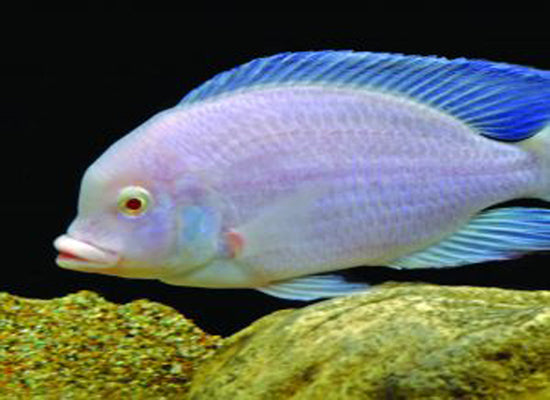
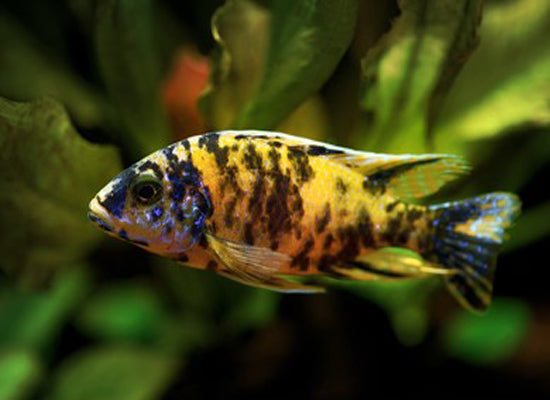
The Malawi Blue Dolphin (Cyrtocara moorii) is a Lake Malawi cichlid, named for the pronounced nuchal hump males develop on the forehead as they mature, giving the profile a dolphin-like curve. In the wild it's found over open sandy stretches and intermediate rock/sand zones of Lake Malawi in East Africa, where it forages by sifting through sand for buried invertebrates — sometimes even following larger cichlids that disturb the substrate, picking off whatever gets stirred up.
This albino form keeps the same gentle, sociable temperament as the standard powder-blue coloring, just without the pigment — pale pink-white body with red eyes. It's one of the calmer Lake Malawi cichlids, notably peaceful for a rift lake species, and does best kept in a small group rather than alone.
Adults reach around 20–25 cm (8–10 inches), with males developing the characteristic head hump; this is a mid-to-large, long-term commitment fish, not a starter cichlid for a small tank.
Sexing is fairly straightforward once fish approach adult size: males grow the pronounced nuchal hump and tend to run larger overall, while females stay smaller and flatter-headed. Like most Malawi haps, this species is a maternal mouthbrooder — after spawning over open sand, the female collects the fertilized eggs into her mouth and carries them for roughly three to four weeks, releasing free-swimming fry only once they're developed enough to fend for themselves. It's a genuinely common and easy species to breed by accident in a mixed Malawi tank once fish mature, which is worth knowing before stocking a group.
In the trade, the albino form is noticeably less common than the standard powder-blue Cyrtocara moorii, and is usually sold as juveniles well under their eventual adult size — it's easy to underestimate how large and how much swimming space this fish will eventually want.
Requirements
A minimum of 350+ litres (90+ US gallons) is recommended for a small group as adults, with a fine sand substrate — this species sifts sand constantly and can injure itself on coarse gravel.
Temperament: unusually peaceful for a Malawi cichlid, which makes it a good "calming" addition to a mixed Malawi community, though it's still large enough to hold its own. It's genuinely one of the few Malawi species that can be kept singly without becoming a problem, but it's also naturally social and tends to be more confident and active kept in a small group of three or more of its own kind.
Diet: omnivorous — a good quality cichlid pellet plus occasional live or frozen food (brine shrimp, mysis); avoid high-protein foods meant for carnivorous fish, as Malawi cichlids are prone to Malawi bloat on rich diets. Feeding small amounts two to three times a day rather than one large feeding reduces waste and the risk of digestive problems in this sand-sifting, grazing-style feeder.
Décor: open sandy areas for foraging alongside some rockwork for other tankmates to claim as territory — this species itself doesn't need caves. Because it spends much of the day moving sand around, live plants are a poor fit here unless they're grown in pots or attached to hardscape rather than rooted directly in the substrate.
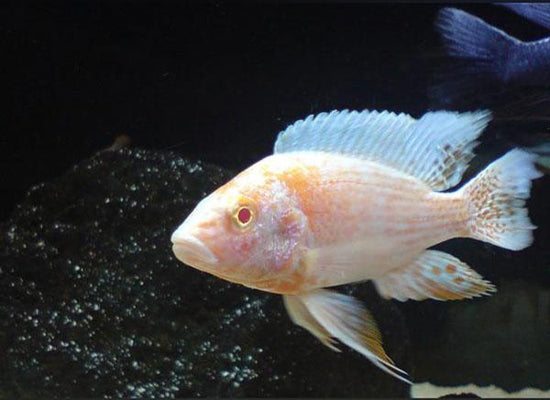
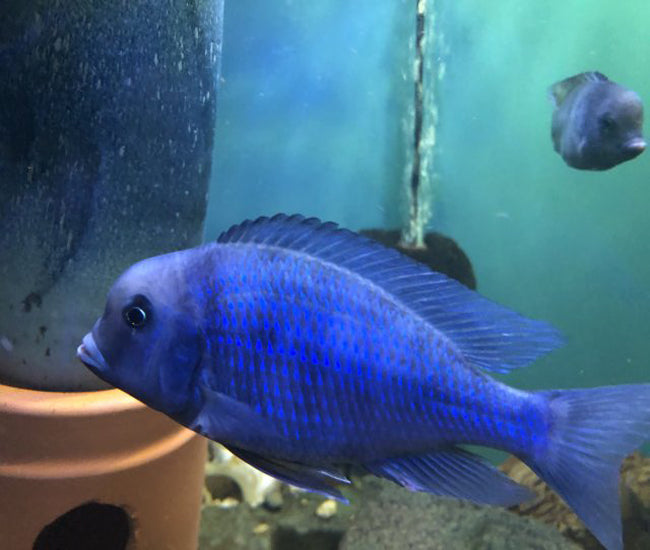
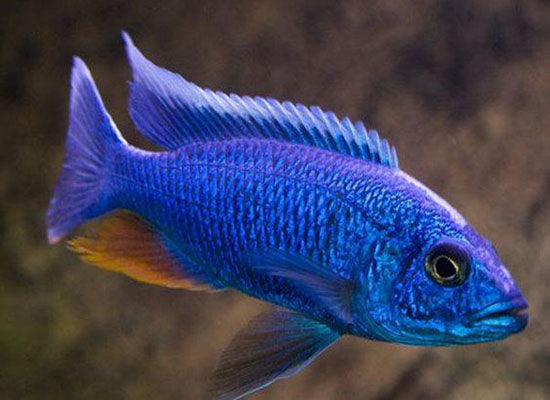
Tankmates: pairs well with other similarly-sized, similarly hard-water Malawi haps and peacocks rather than the more aggressive mbuna, which can bully its calmer temperament; also does poorly mixed with soft-water South American or Central American cichlids since their water chemistry needs directly conflict.
Filtration: given the size this fish reaches and the amount of sand it moves daily, oversized mechanical and biological filtration pays off — undersized filtration is one of the more common reasons keepers see cloudy water or elevated nitrates in a Malawi setup. A canister filter or a sump rated well above the tank's actual volume is a sound investment from the start rather than something to upgrade to later.
Compatibility
Water & Care Conditions
These parameters follow the natural chemistry of Lake Malawi's Rift Valley water — they aren't flexible in the way softer-water community fish can be:
- pH: 7.8–8.6 (Lake Malawi is naturally hard and alkaline — this is not optional, low-pH water stresses these fish over time)
- Water hardness: 10–20 dGH (200–350 ppm); many keepers add crushed coral or aragonite sand to the substrate/filter to hold pH and hardness up long-term
- Temperature: 24–28°C (75–82°F)
- Oxygenation: strong surface agitation and filtration — Malawi cichlids are messy, heavily-stocked-tank fish that need robust biological filtration and large, regular water changes
- Filtration turnover: aim for at least 6-8x the tank volume per hour, since this species and its typical Malawi tankmates produce a heavy bioload relative to their size
- Ammonia/nitrite: should read zero at all times in an established tank — Malawi cichlids are notably less tolerant of poor water quality than many community fish, and stress from ammonia spikes is one of the more common triggers for Malawi bloat
Because this species sifts sand for hours a day, keep the substrate clean and avoid anything sharp. Watch for the early signs of Malawi bloat — loss of appetite, laboured breathing, pale stringy faeces, and a swollen abdomen — since it progresses quickly and is much easier to head off with a water change and a short fast than to treat once advanced. Weekly 25-30% water changes and consistent pH/hardness (avoid letting parameters drift between water changes) do more to prevent it than any single piece of equipment.
Test pH, ammonia, nitrite, and nitrate weekly while a tank is still maturing, and at least monthly afterwards, since Rift Lake buffering material (crushed coral, aragonite) can exhaust itself gradually and let pH creep down without any obvious visual sign until fish start showing stress. New water used for changes should be matched to tank temperature and, ideally, pre-adjusted for hardness rather than added straight from a soft-water tap, to avoid repeated chemistry swings.