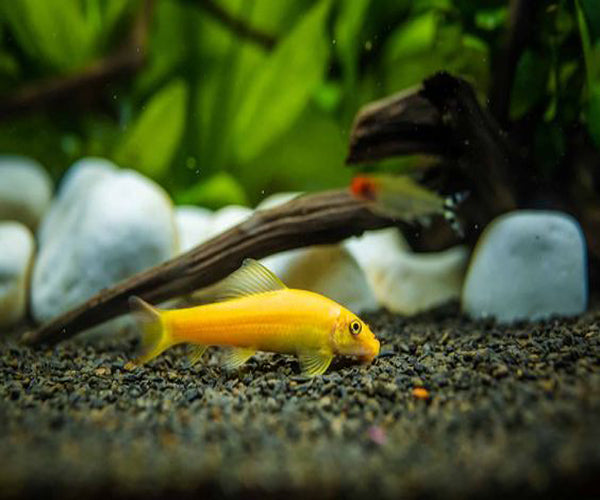
About & Origin
The Golden Algae Eater is a freshwater fish, a colour form of Gyrinocheilus aymonieri, commonly known as the Chinese Algae Eater despite being native to fast-flowing rivers and streams of Southeast Asia -- Thailand, Laos, and parts of Vietnam and southern China. In the wild it clings to rocks in strong current using a specialised sucker-like mouth, grazing algae off submerged surfaces.
It's one of the most recognisable "algae eater" fish sold in the hobby, and the golden/xanthic colour form seen here is a selectively bred variant of the same species rather than a different fish. Young individuals are genuinely excellent, dedicated algae grazers, which is the main reason this species became so popular.
The important honest caveat: this species changes significantly with age. As it matures (it can reach 25–28cm in ideal conditions, though usually smaller in aquaria), it becomes increasingly territorial towards its own kind and other bottom-dwelling, similarly-shaped fish, and its diet shifts away from pure algae-grazing towards a more general, sometimes opportunistic feeding style.
A common point of confusion in the hobby is mixing this fish up with the true Siamese Algae Eater (Crossocheilus species), which stays smaller, more peaceful, and a more reliable long-term algae grazer. The two are sold under overlapping common names but are genuinely different fish with different long-term temperaments -- worth knowing before you buy based on the "algae eater" label alone. What sets Gyrinocheilus apart physically is its specialised, disc-like sucking mouth, which it also uses to breathe by drawing water over its gills while clamped to a surface, a genuine adaptation to life in fast, oxygen-rich current where simply swimming and gill-pumping in open water is less efficient.
In the trade, Golden Algae Eaters sold in shops are near-universally farm-raised in large numbers in Southeast Asia rather than wild-caught, and the golden colouring is fixed by selective breeding over generations rather than being a rare wild morph. Given reasonable care, this is a long-lived fish for an algae-eating species, commonly reaching 6-10 years in a well-maintained aquarium, which reinforces why its eventual adult size and temperament are worth planning for from the start rather than treating it as a disposable "cleanup crew" fish.
Requirements
Golden Algae Eaters are excellent algae control as juveniles, but this is a species where planning ahead for its adult size and temperament genuinely matters.
Solitary as adults: keep only one per tank once mature -- multiple individuals will fight for territory, sometimes seriously.
Tank size: a young fish is fine in a modest planted tank, but this species needs upgrading room -- ideally 100cm/40 inches or more as it approaches full size.
Strong water flow: as a fast-current native species, it appreciates good filtration flow and oxygenation, more so than most community fish.
Diet as it ages: supplement with algae wafers, blanched vegetables, and occasional protein once natural algae supply in the tank can no longer keep up with an adult's appetite.
Avoid pairing with slow, flat-bodied fish: older individuals have a known tendency to rasp the slime coat of slow-moving, flat-sided fish (like some larger flat-bodied cichlids); this is worth knowing before stocking a mixed tank long-term.
Décor and hiding spots: provide rockwork, driftwood, or other hard surfaces with algae growth for it to graze on naturally, plus some visual barriers (plants, ornaments) so a mature, territorial individual has a defined patch rather than contesting the whole tank.
Quarantine before adding to an established tank: like most farmed fish sold in large batches, individuals can arrive stressed or carrying minor parasites; a 2-3 week quarantine period with careful observation before introducing it to a display tank reduces the risk of introducing disease to existing stock.
Feeding schedule as an adult: once natural algae can no longer sustain it, offer algae wafers or blanched vegetables (courgette, spinach, cucumber) 3-4 times a week, plus occasional protein (bloodworm, brine shrimp) once or twice weekly to round out its diet -- this species becomes more omnivorous with age and genuinely needs the variety.
Compatibility
Water & Care Conditions
Golden Algae Eaters are hardy and adaptable to a wide chemistry range, reflecting their fast-river origin.
- pH: 6.5–8.0
- Hardness: soft to moderately hard, roughly 5–20 dGH
- Temperature: 22–28°C (72–82°F)
- Oxygenation: needs strong water movement and high dissolved oxygen, reflecting its native fast-flowing-river habitat -- underperforms in still, low-flow tanks
- Filtration: an oversized filter for the tank volume, or an added powerhead/wave maker, helps replicate the current it evolved in and keeps it active and healthy long-term
- Water changes: weekly 20-30% water changes help keep nitrates low, which matters more for this species' long-term coloration and activity level than for many hardier community fish
- Disease susceptibility: generally hardy and not unusually prone to disease when water quality is maintained, though like most scaled freshwater fish it can develop ich (white spot) if stressed or chilled -- standard quarantine and gradual temperature acclimation reduce this risk
- Acclimation: drip-acclimate new arrivals slowly over 30-45 minutes rather than a quick temperature-matched dump, since this species can be more sensitive to abrupt chemistry shifts during transport stress than its overall hardiness would suggest
This is a genuinely hardy fish on water chemistry -- the real long-term care consideration for this species is tank size and temperament management as it matures, not water parameters. Sudden swings in temperature or pH are a bigger practical risk to it than living slightly outside its "ideal" range for an extended period, so consistency matters more than chasing an exact number.
Because it evolved clinging to rock faces in current rather than swimming freely in open water for long stretches, this species is also more sensitive than many community fish to ammonia and nitrite spikes during a tank's initial cycling period -- avoid adding it to a brand-new, uncycled aquarium, and test water parameters regularly for the first few weeks after introducing it to any new setup.