About & Origin
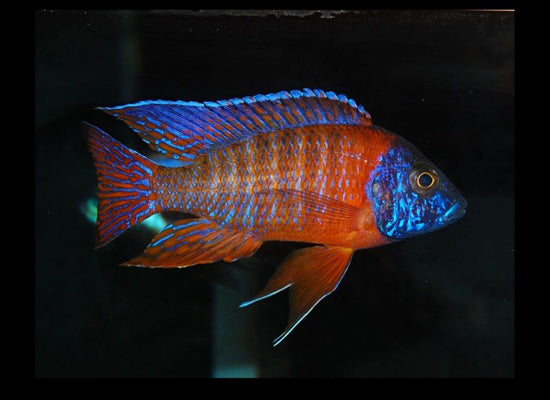
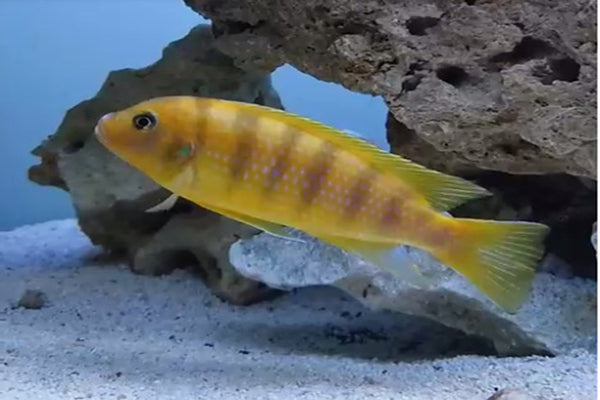
Red Peacock is a Malawi peacock cichlid (Aulonocara sp.) colour strain, one of the most commonly requested in the hobby, bred for a deep, saturated red-orange rather than the more common paler orange or yellow lines — the depth of red is what breeders select for generation to generation.
In the wild, Aulonocara hunt over sand and mixed rock/sand zones along Lake Malawi's shoreline in East Africa, sensing buried invertebrates with a pore-covered snout — worth replicating with real open sand in the tank rather than wall-to-wall rockwork.
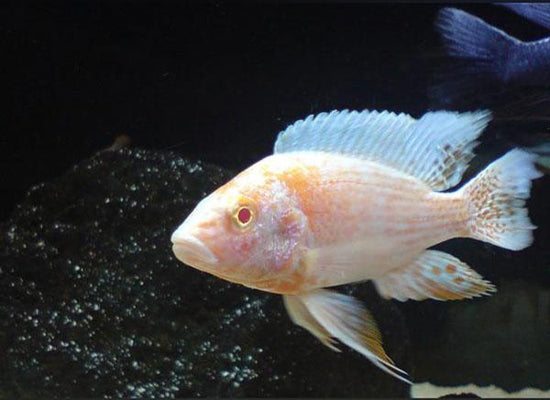
Colour is a male-only, maturity-linked trait across all peacocks: females and juveniles stay plain silvery-grey, and a young Red Peacock needs several months of growth and territory-holding before the red fully develops.
Aulonocara peacocks are maternal mouthbrooders: after spawning, the female collects the fertilised eggs in her mouth and carries them — without eating — for roughly three to four weeks until the fry are large enough to swim and feed independently. In a mixed-sex group this happens readily without any special intervention, and holding females can be left in the main tank or moved to a breeding trap if you want to maximise fry survival, since other tankmates will happily eat any fry that wander off unsupervised.
When choosing individuals, look for a fish with clear eyes, an even, undamaged fin edge, and — in males — colour that's already showing rather than a washed-out juvenile pattern, since colour intensity in adulthood is difficult to predict from a very young fish. Peacocks are also prone to the same Malawi bloat and internal parasite issues as other rift lake cichlids if kept on a high-protein or poor-quality diet, so a stable, appropriate diet from the start matters more for long-term health than tank decor.
Requirements
The same core Malawi peacock requirements apply across the range: 200+ litres (55+ gallons) for a small group with one male, semi-aggressive but calmer than mbuna, African cichlid pellets plus frozen brine or mysis shrimp, rockwork broken into distinct territories with open sand left for foraging, and slow drip acclimation for new arrivals.
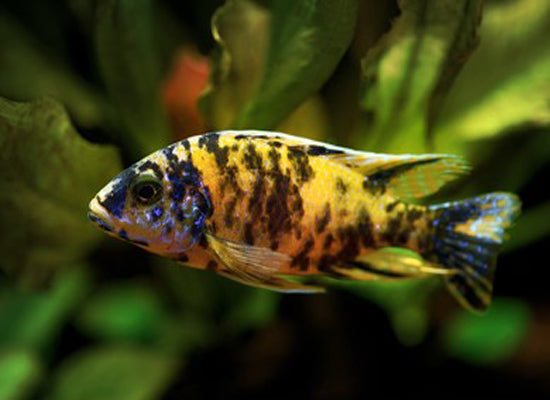
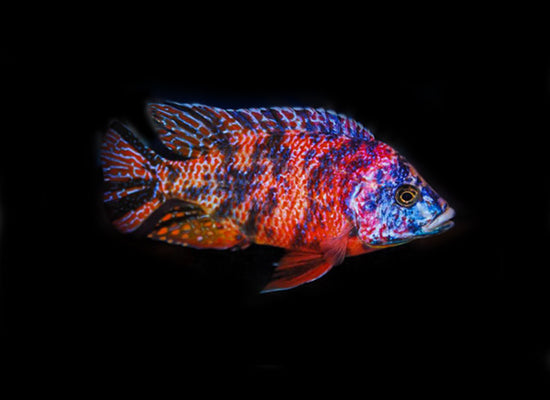
Stocking this strain specifically: Red Peacock's saturated colour makes it a strong visual centrepiece in a mixed peacock/hap community, but avoid stocking it with other deep-red or red-orange strains (like Orange Marf) in the same tank — rival males that look alike compete far more intensely for territory and female attention than differently-coloured ones do.
Sexing: males colour up fully at maturity; females and juveniles stay silvery-grey throughout, making ratio planning easy once fish are old enough to tell apart.
Group ratio: one male per several females (roughly 1:3 or more) spreads breeding attention and reduces stress on individual females -- a small group or too few females tends to concentrate aggression rather than diffuse it. Rockwork broken into distinct visual territories also helps reduce ongoing conflict between the dominant male and any subordinate males present. Avoid stocking two similarly bright red or orange peacock strains together, since visually alike rival males compete far more intensely than differently-coloured ones do.
Compatibility
Water & Care Conditions
- pH: 7.8–8.6, hard and alkaline like the rest of the peacock range
- Water hardness: 10–20 dGH (200–350 ppm)
- Temperature: 24–28°C (75–82°F)
- Water changes: 25–30% weekly with strong filtration
A red that's turning orange or looking faded rather than deep and saturated is a useful visible cue for this strain specifically — worth checking water quality before assuming it's just a slow colour-up in a young fish. Ammonia and nitrite spikes are poorly tolerated even though the species is otherwise fairly hardy, so a fully cycled tank before introduction matters more than the parameter ranges alone suggest.
New arrivals can take several weeks to settle and show full colour; a persistently dull or clamped-fin fish beyond that window is worth investigating rather than dismissed as normal adjustment. Keep ammonia and nitrite at zero once cycled — most unexplained losses trace to filtration or stocking rather than the fish being delicate. A buffered substrate (crushed coral or aragonite mixed in) helps hold the required hard, alkaline chemistry stable over time, especially where tap water runs naturally soft. Well-kept peacocks of this type commonly live 6–8 years, with diet variety -- African cichlid pellets plus occasional frozen mysis or brine shrimp -- directly supporting both growth and how saturated the red colouring becomes at maturity.